Skip to content
MenuClose
PalletLinker

Sizes / metric world

Euro & EPAL 1200 × 800 mm

If your freight is crossing the Atlantic or your racking came from Germany, you need Euro. The brands on the corner blocks matter as much as the dimensions — here is how to read them.

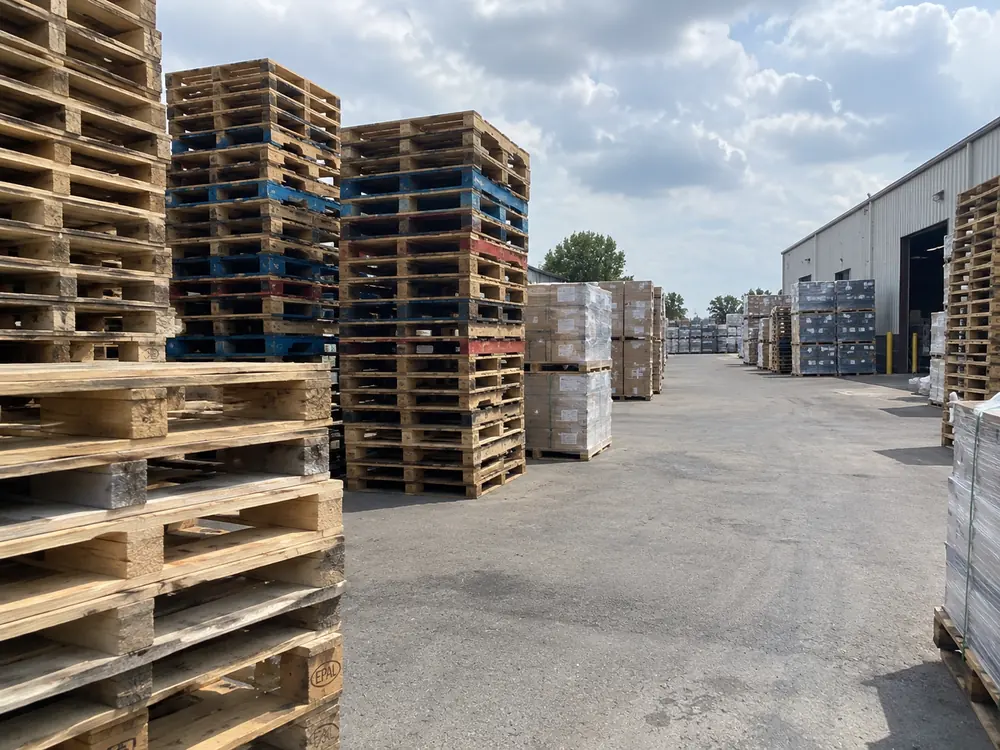
Outdoor pallet yard with mixed stacks, including marked pool pallets, under a cloudy skyThe yard
Outdoor sorting yard

Request a quote

Put this page into a quote.

The fields below reach the same yard team that wrote this page. Tell us the size, the count and the grade you think you need — we will confirm it or correct it, in writing, within one business day.

Portland, OR · email only, no phone

A mailbox you actually read — this is how we reply.
US or Canada, 10 digits — format (503) 274-0900.
US ZIP or Canadian code.
Type freely or pick from the list.
Whole number — per month or one-time.

Required fields are marked *. We validate every entry, so a typo in your email or ZIP will be flagged before the request is sent. Read our privacy note.

A Euro pallet is a block pallet measuring 1200 × 800 mm, built to a tightly controlled specification and branded on the corner blocks. The brand is the point: an unbranded pallet of the same size is just a pallet, and it will not be accepted into an exchange pool.

We stock used EPAL-branded stock and we will tell you honestly when the market is tight. Euro pallets are a managed pool, prices move, and anyone promising permanent availability is guessing.

Specifications

Numbers you can plan around

Published, honoured, and quoted back to you in writing on every order.

AttributeEPAL / EUR 1Euro 2Euro 3Euro 6
Size1200 × 800 mm1200 × 1000 mm1000 × 1000 mm800 × 600 mm
Imperial47.2" × 31.5"47.2" × 39.4"39.4" × 39.4"31.5" × 23.6"
Blocks9999
Tare weight22–25 kg33 kg28 kg9.5 kg
Safe working load1,500 kg1,250 kg1,250 kg500 kg
Racked load1,000 kg1,000 kg1,000 kg250 kg
Nails per pallet78, specified pattern787848
Mark locationBoth outer blocksBoth outer blocksBoth outer blocksBoth outer blocks

Reading the corner block

On a compliant pallet the left outer block carries the railway or EPAL oval, the centre block carries the IPPC heat-treatment stamp, and the right block carries the EUR or EPAL mark plus the licence number of the producing plant and the production year.

If the oval is missing, painted over or clearly stamped on afterwards with a different nail pattern underneath, treat the pallet as a plain block pallet. We grade this way and we will say so on the quote.

Grades in the Euro pool

Euro grades are their own language. 'New' is self-explanatory. 'Grade A' or 'Euro 1' means light use, clean, no repairs visible, bright wood. 'Grade B' or 'Euro 2' means visibly used with possible repairs, structurally perfect, darker wood. 'Grade C' is functional but tired and generally not accepted in exchange.

For export packaging where the pallet will not come back, Grade B is almost always the right answer. For an exchange pool or a customer audit, specify A.

Exchange, one-way, or buy outright

There are three ways to use Euro pallets and they have very different economics. Exchange pools assume the pallet returns; one-way means you accept the pallet is gone and should buy the cheapest compliant grade; outright purchase suits closed-loop operations between two of your own sites.

Tell us which model you are running and we will quote the grade that fits rather than the grade that sounds impressive.

Why Euro availability moves in North America

Euro pallets arrive here as a by-product of imports: they come in loaded with European goods and then sit, because almost nothing shipping out of the United States is palletised on a 1200×800 footprint by default. Domestic supply is therefore a function of European import volume, not of domestic demand.

When imports slow, the used Euro pool tightens within weeks and no amount of local sorting capacity changes it. Anyone promising permanent Euro availability at a fixed price is guessing, and we would rather tell you a market is tight than revise a quote later.

Exchange, one-way, or outright purchase

Three models with very different economics. Exchange pools assume the pallet returns and therefore need genuine branded EPAL stock. One-way shipping means you should buy the cheapest compliant grade, because the pallet is gone. Outright purchase suits closed loops between two of your own sites.

Tell us which model applies and we will quote the grade that fits rather than the grade that sounds impressive. Specifying Grade A for a pallet that will be scrapped on arrival in Rotterdam is one of the more common ways to overspend in packaging.

PalletLinker published ratings. Quoted back to you in writing on every order. Racked figures assume edge support only, evenly distributed, no overhang.
PalletDynamicRacked
48×40 GMA Grade A2,800 lb2,200 lb
48×40 GMA Grade B2,200 lb1,500 lb
48×40 block 4-way2,500 lb2,400 lb
EPAL / Euro 13,300 lb2,200 lb
Remanufactured2,000 lb1,200 lb

Money

How a pallet price is actually built

Four inputs, in descending order of importance. None of them is a list price, which is why we quote rather than publish.

Today's pool depth
How many units of that footprint and grade are physically in the yard this week. Used stock is not manufactured on demand.
Grade and screening
Grade A costs more than B because the yield is lower, not because the wood is different. Screened automation pools cost more again.
Freight
Always itemised separately. Paired loads — where your delivery rides with a collection — are priced lower because they genuinely cost us less.
Volume and commitment
A quarterly supply program fixes a price and reserves stock. Spot buying at peak is the most expensive way to buy pallets.
  • New 48×40 palletindex 100
  • Grade A recycled45–55
  • Grade B recycled30–40
  • Remanufactured25–35
  • Repairing your own40–55% of replacement

Indicative cost index against a new pallet of the same footprint. Purchase price is typically only 5–15% of a pallet's total cost per trip — freight weight, damage and receiving-dock rework are usually larger. The full arithmetic

Process

How a first order actually happens

No sales team, no discovery call, no CRM sequence. We have no telephone, so everything below happens in writing and stays searchable afterwards.

  • What we need: footprint, grade, count, ZIP, and how the pallet is handled.
  • Nice to have: a photo, your dock height, whether you run forklifts or jacks.
  • Not needed: a purchase order, an account, or a phone conversation.
  1. 01

    You send the form

    Every form on this site is the same form and reaches the same yard team. Required fields are validated as you type, so a mistyped ZIP or email is caught before anything is sent.

  2. 02

    We check today's stock

    Used pallet availability moves daily. You get a real count and a real date rather than a list price that was true last quarter.

  3. 03

    A written quote, within one business day

    Price per unit by grade, freight itemised separately, delivery window, and any honest reservations we have about the specification you asked for.

  4. 04

    Delivery, count, paperwork

    Signed count sheet on arrival, weight ticket where relevant, and a diversion certificate for anything we collect for recycling.

  • 01

    Published specifications

    Grade definitions, dimensional tolerances and racked load ratings in writing. Most yards will not publish a racked figure at all.

  • 02

    Hand graded, four-hour triage

    Two graders per line, flipped and sounded. Every inbound load is triaged within four working hours so nothing rots in a mystery pile.

  • 03

    Zero landfill, measured

    Weighed in, weighed out, reconciled monthly. Zero pounds landfilled in 2025, with a certificate you can hand to an auditor.

  • 04

    Everything in writing

    No phone line by choice. Every price, date and commitment lives in an email you can search, forward and hold us to.

  • 05

    Repair before replacement

    A repair bay, a kiln, a de-nailer and a grinder on site. Repairing a pallet avoids roughly 11 kg CO₂e and costs you half of new.

  • 06

    Traceable by stamp

    Every unit carries a Pallet Passport ID burned into a stringer. Type it in and read its species, cycles, repairs and carbon ledger.

Receiving

What to check on delivery

Eleven minutes on the first three deliveries sets the tone for the whole relationship. Do this with any supplier, including us.

CheckHowPassIf it fails
Overall sizeTape measure, both dimensions, one pallet in tenWithin 1/4" (Grade A) or 1/2" (Grade B)Note it on the delivery ticket
SquarenessSteel square in two opposite cornersWithin 1/4" on the diagonalReject the unit; we replace next route
Protruding nailsPalm flat across the top deckNothing catchesReject — this is what tears packaging
Bottom boardsFlip one pallet in tenNo split through a nail lineReject; it will fail in a rack
MoistureLift one. Wet pallets are 8–10 lb heavierFeels dry, sounds sharpFloor stack to dry, do not rack at rating
Mould or stainingVisual, both decksWeathering only, no fuzzReject for any food-contact use
Grade mixCount against the delivery noteMatches what you orderedAsk for the count sheet to be corrected

Write failures on the delivery ticket rather than calling — a written record is the only thing that reliably changes supplier behaviour, and we replace rejected units on the next route with no restocking charge.

Avoid these

Six expensive mistakes

Every one of these has cost a customer real money in front of us.

  • 01

    Buying on unit price alone

    Purchase price is 5–15% of total cost per trip. Tare weight, damage rate and receiving-dock rework are usually larger line items, and none of them appear on a quote comparison.

  • 02

    Accepting overhang

    A load extending even an inch past the deck transfers weight into the packaging instead of the pallet. Case compression strength drops sharply and the damage appears three handling events later, in somebody else's warehouse.

  • 03

    Racking on a dynamic rating

    Dynamic is what a pallet carries while being moved. Racked — supported only at its edges — is smaller and is the only number that matters in beam racking. Ask for it in writing.

  • 04

    Specifying Grade A out of habit

    For one-way shipping, floor stacking and closed loops, Grade B does the same job for roughly 20% less. Over-specifying is paying for appearance.

  • 05

    Storing pallets on bare ground

    Two spare pallets as a base and a tarp that reaches the sides will keep a stack usable through a Portland winter. A soaked pallet gains nine pounds of paid freight weight and loses stiffness.

  • 06

    Forgetting that dunnage needs a stamp

    On export loads the bracing, blocking and chocks are solid wood packaging too. One untreated board can hold an entire container at a foreign port.

The yard

What stands behind this page

  • 14kpallets graded monthlytwo hand-grading lines
  • 1,100heat treated per dayISPM-15, chart recorded
  • 4.1M lbwood diverted last year68% reused whole
  • 0 lblandfilled in 2025weighed and reconciled

What this means for your reporting

Reuse is the cheapest emissions reduction available in logistics, and it is also the easiest to document. We model a new 48×40 softwood pallet at 14.2 kg CO₂e — lumber production, fasteners, assembly and delivery — and a reuse cycle at 3.1 kg, covering collection, repair materials, yard overhead and redelivery. The difference, 11 kg CO₂e per reuse, is the figure we publish.

We also publish the caveat: that figure assumes a reused pallet genuinely displaces the manufacture of a new one. Economists call the gap leakage, and nobody in this industry can honestly claim it is zero. We think displacement is high because the pallet market is regional and price-responsive, but we will not pretend it is perfect.

Which is why we lead with the number that needs no assumptions: measured landfill diversion. Landfilled wood decomposes anaerobically and releases methane, roughly 28 times worse than CO₂ over a century. Keeping four million pounds of wood out of a hole in the ground is a benefit you can weigh.

Per-unit figures

New pallet
14.2 kg CO₂e (range 12.8–16.1)
Reused graded pallet
3.1 kg CO₂e
Repaired customer-owned
2.2 kg CO₂e
Avoided per reuse
11 kg CO₂e, published
Wood kept in service
33–37 lb per unit
Biogenic carbon stored
~26 kg CO₂-equivalent
The full derivation

Questions

Asked often

Can you guarantee branded EPAL stock?

We can guarantee what is in the yard the day we quote. We will not promise standing availability, because North American Euro supply depends on European import volume rather than on our purchasing.

Is an unbranded 1200×800 pallet acceptable?

For one-way export to a receiver who will absorb or scrap it, usually yes, and it costs considerably less. For an exchange pool or an audited requirement, no — the brands are the point.

Do Euro pallets need heat treatment too?

Yes, if they are travelling internationally. Compliant EPAL stock normally carries the IPPC stamp on the centre block already; we verify it before shipping.

Questions

What people ask about euro & epal 1200 × 800 mm

What is the minimum order or pickup?

No hard minimum for collection at the yard — come and take four pallets on a Saturday morning if you like. For delivery it is 50 units inside Portland metro and 150 outside it, because the truck has to earn its diesel. Outside our 180-mile fleet radius we quote through partner yards and freight, with the lane itemised.

How fast can this happen?

Standard 48×40 Grade A and B stock: same day for pickup, next day for metro delivery. Block pallets one to three days. Custom builds five to nine business days; engineered runs two to three weeks. Heat treatment is same day for booked batches and 48 hours standard. Written quotes always come back within one business day.

Why is there no phone number anywhere?

Because verbal quotes get remembered differently by different people. Since 2018 every price, date and commitment we make exists in an email you can search and forward. Most customers dislike it for about a month and then prefer it. Everything else happens in person at 3821 NW St Helens Rd, Portland, OR 97210.

Can I inspect before committing?

Please do. Visit the yard by email arrangement — closed-toe boots required, hi-vis provided — or ask for photographs of the actual pool your order would come from. We would rather lose an order than have a customer discover a surprise on their dock.

What documentation comes with it?

A written quote, a signed count sheet by grade, a weight ticket where material is weighed, heat-treatment certificates for treated batches (archived seven years), and a monthly diversion certificate for anything we collect for recycling — measured pounds kept out of landfill, which is the figure your ESG report actually needs.

What will you refuse to do?

Take methyl-bromide fumigated, chemically contaminated or fire-damaged wood. Buy marked rental-pool pallets, which belong to their operator. Promise same-day delivery outside the metro. Or quote a grade we do not think will survive your handling — we will specify downward and explain why.

Vocabulary

Terms used on this page

Defined the way a yard uses them, not the way a standards document does.

EPAL
The European Pallet Association, whose brands appear on compliant Euro pallet corner blocks.

The full glossary, 36 terms

Decision table

Five ways to get a pallet, compared honestly

Including the two we do not sell. Cost index is against a new wooden pallet of the same footprint.

Indicative figures for a 48×40 footprint in the Pacific Northwest, 2026. Rental pool economics vary by contract and are deliberately shown as a range.
OptionCost indexTripsRepairableCarbon per useBest forWatch out for
Grade A recycled45–559–14 then repairYes3.1 kgAlmost everythingColour varies; tare varies by a few pounds
Grade B recycled30–407–11 then repairYes3.1 kgOne-way, floor stacking, closed loopsLower racked rating (1,500 lb)
Remanufactured25–355–8Yes4.8 kgOne-way on a budgetVisibly mixed boards; 1,200 lb racked
New wooden10015–20 then repairYes14.2 kgTight tolerances, audits, odd sizesPays for appearance you may not need
Plastic500–1,00030–100NoHigh embodied, low per-useWash-down, deep freeze, pharmaCracks end its life; not repairable
Rental poolPer-trip feeManagedBy operatorOperator's figureExchange networks, retail mandatesPallets are not yours; losses are chargeable

We sell the first four and supply plastic where a wash-down line genuinely needs it. We do not operate a rental pool, and we will not buy marked pool pallets from you — they belong to their operator. Full comparisons

Worked example

Cost per trip, calculated properly

A real comparison for a plant shipping 600 pallets a month on a weight-sensitive lane. Copy the method, not the numbers.

Illustrative. Your lane rate, damage rate and disposal cost will differ — the point is that unit price is the smallest line in the table.
LineNew palletGrade A recycledGrade B recycledNote
Unit purchase price (index)1005035The only number most procurement systems compare
Trips before repair15–209–147–11New lasts longer; it also costs twice as much
Purchase cost per trip (index)5.64.33.8Price divided by trips
Tare weight36 lb35 lb33 lbRecycled fir is often lighter than new hardwood
Freight weight penaltyBaselineNeutral−3 lb/unitOnly matters on weight-limited lanes
Expected damage rate0.3%0.3%0.4%Graded stock behaves; ungraded stock does not
Receiving rejectionsRareRareOccasionalGraded + written tolerance removes most of this
End-of-life cost000We collect and pay or collect free — never a disposal fee
Documentation valueNoneDiversion certificateDiversion certificateReportable ESG outcome at no extra cost
  • Purchase price share of total cost5–15%
  • Freight weight share~30%
  • Damage & rework share~38%
  • Handling labour share~20%

Build this yourself

One row per option, six columns: unit price, tare weight, expected trips, damage rate, rejection risk, disposal cost. Multiply out across annual volume. It takes an afternoon, the cheapest unit price almost never wins, and we will happily help build it — including with numbers that do not favour us.

The full article

Diagnostics

Read the damage, fix the cause

Damage patterns are not random. Each one points at a specific handling behaviour, and fixing the behaviour is worth more than fixing the pallets.

What you seeWhat it almost always meansWhat to changeCost to fix
Split lead boards at one endForks driven in too fast and too highOperator training; dock lighting. Usually one shift is responsibleFree
Torn stringer notchesPallet jacks entering notched stringers at an angleSpecify block pallets with true four-way entrySpec change
Bottom boards ripped off cleanlyPallets dragged rather than lifted, or frozen to a cold-store floorFloor condition, forklift capacity at peakLow
Crushed corner blocksStacks higher than the rating, or uneven loads on one cornerStack-height policy; centre the loadFree
Out of square, nothing brokenRacking loading pallets diagonally — beams at different heightsRack survey. This one is worth chasingMedium
Mould in the middle of a stackWet pallets stacked tight with no airflowStore off the ground, cover the top, leave side gapsLow
Protruding nails tearing casesUngraded stock, or units repaired without re-checkingBuy graded; reject on the ticketFree
Deck boards cuppingMoisture cycling between a freezer and a humid dockKiln-dried pool; helical fastenersSpec change

Keep thirty of your own broken pallets aside for a month and photograph the damage. Patterns appear quickly. We do this analysis free with any repair quote, because a customer whose damage rate halves buys from us for a decade.

Storage

Keeping pallets usable through a wet winter

Portland takes about 36 inches of rain a year and most of it lands between November and March. You do not need a building to survive that — you need three habits.

Off the ground
Two spare pallets as a base. Anything touching soil wicks water and rots from the bottom layer up.
Covered on top
A tarp that actually reaches the sides. Rain enters a stack from above, not from the side.
Air gaps, not a seal
A sealed tarp traps condensation and produces the mould problem you were avoiding. Leave the sides open.
Away from drip lines
Anything under a roofline drip edge stays wet all winter, regardless of what you cover it with.
Aligned with the wind
Stacks oriented with prevailing wind dry noticeably faster. Free, and it works.
Rotate the pile
First in, first out. The bottom of an untouched stack is where pallets go to die.
What moisture does, measured on our own scale and grading line.
ConditionWeightStiffnessRack it?
Kiln dried (≤19% MC)33 lbFull ratingYes
Air dried, covered35 lbFull ratingYes
Damp, uncovered 2 weeks39 lbReducedFloor stack
Rain-soaked45 lbMaterially reducedNo — let it dry
Frozen wet45 lb+UnpredictableNo

Nine pounds of water per pallet is nine pounds of freight you pay to move. Across 600 units that is more than two and a half tonnes of water on a truck. Field notes on moisture

Freight

What fits in what

Pallet counts per vehicle and container, so you can sanity-check a quote before you accept it.

Empty pallets, stacked, with typical safe stack heights. Loaded counts are governed by your product, not by the pallet.
EquipmentFloor positions (48×40)Empty pallets stackedNotes
53' dry van30up to ~560The standard North American trailer
48' dry van26up to ~500Still common on regional lanes
48' flatbed26up to ~520Our workhorse for yard-to-yard moves
53' curtain-sider30up to ~560Weather protection with side access
26' box truck, lift-gate12up to ~240Urban docks with no forklift
40' ocean container20up to ~400ISPM-15 marking required
40' high-cube container20up to ~460Extra height, same floor
20' ocean container10up to ~200Heavy, dense loads
40 yd hook-lift containern/a~90 loose coresFor standing recycling bins

Pallet freight is almost always weight-constrained before it is cube-constrained, which is why tare weight is a real cost line. How we price a lane

Reference

Standards, bodies and who decides what

Pallets sit under a surprising number of overlapping rules. Here is who writes them and what they actually govern.

ReferenceWho maintains itWhat it governsDoes it bind a used pallet sale?
ISPM-15IPPC, under the UN FAOTreatment and marking of solid wood packaging in international tradeYes, for export
GMA footprint (48×40)Industry convention, originally grocery manufacturersA footprint, not a quality levelNo — it is a size
EPAL / EUREuropean Pallet AssociationEuro pallet construction, repair and brandingYes, if sold as EPAL
ISO 6780International Organization for StandardizationPrincipal pallet footprints worldwideNo
ASTM D1185 / D1083ASTM InternationalTest methods for pallet performanceNo, but ratings reference them
PDS (Pallet Design System)Virginia Tech / NWPCAEngineering-grade load modellingNo — a design tool
NWPCA uniform standardsNational Wooden Pallet & Container AssociationCommon grade vocabularyVoluntary
OSHA 1910.176US Dept of LaborSafe storage, stacking and housekeepingYes, in your building
Oregon EPR (SB 582)Oregon DEQProducer responsibility for packaging; wood is in scope for reportingIncreasingly, yes
FSMA / food safety plansUS FDAPackaging as a food-contact hazard considerationVia your audit, yes

The gap in that list is the interesting part: no authority grades used pallets. That is why a written supplier specification — ours is published here — is the entire quality system in this industry.

Next step

Shall we put a number on it?

Email reaches the same yard team that graded the stock. Written quotes, one business day, no phone tag.

Get a quote