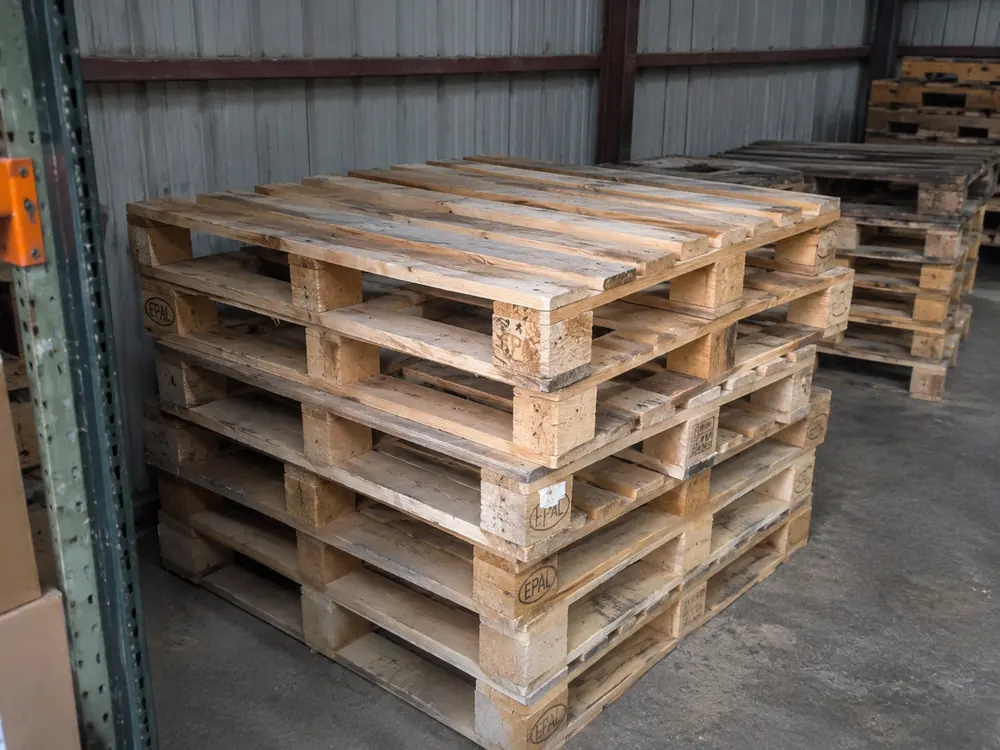
Built
Douglas fir from a mill inside 180 miles. Seven top boards, five bottom, three stringers, helical nails, 2,800 lb dynamic.
Request a quote
Type the size into Product type, add a count, and we will come back with today's availability and a per-unit number.
Portland, OR · email only, no phone
Interactive
Every row renders even with JavaScript switched off — the filters are a convenience, not a gate.
| Footprint | Imperial | Metric | Entry | Region | Typical use | Stock | Note |
|---|---|---|---|---|---|---|---|
| GMA / North American standard | 48" × 40" | 1219 × 1016 mm | 4-way notched | North America | Grocery, beverage, general freight | Deep | 30%+ of all pallets in the United States. |
| Euro / EPAL 1 | 47.2" × 31.5" | 1200 × 800 mm | 4-way block | Europe | Export, automotive, pharma | Good | Must carry EPAL/EUR brands on the corner blocks. |
| Euro 2 / industrial | 47.2" × 39.4" | 1200 × 1000 mm | 4-way block | Europe / ISO | Chemicals, drums | On request | Closest metric cousin to the GMA footprint. |
| Euro 3 | 39.4" × 39.4" | 1000 × 1000 mm | 4-way block | Europe | Liquids, IBC bases | On request | Square footprint, easy to rotate in tight bays. |
| Euro 6 / half Euro | 31.5" × 23.6" | 800 × 600 mm | 4-way block | Europe | Retail display | On request | Display pallet for grocery aisles. |
| Beverage | 42" × 42" | 1067 × 1067 mm | 4-way notched | North America | Soft drinks, dairy, kegs | Good | Square deck keeps round product centred. |
| Drum pallet | 48" × 48" | 1219 × 1219 mm | 4-way | North America | 55-gal drums, paint, resin | Good | Four drums per deck, evenly loaded. |
| Military / MIL-STD | 40" × 48" | 1016 × 1219 mm | 4-way | North America | Defence, aerospace | On request | GMA rotated; watch the orientation on your drawing. |
| Half pallet | 48" × 20" | 1219 × 508 mm | 2-way | North America | Retail ready, end caps | Good | Two halves make a standard footprint. |
| Quarter pallet | 24" × 20" | 610 × 508 mm | 2-way | North America | Promotions, display | Good | Hand-truck friendly, popular with grocery. |
| Nursery deck | 36" × 36" | 914 × 914 mm | 4-way | Pacific NW | Pots, soil, shrubs | Deep | Wide deck gaps for drainage and airflow. |
| Produce / agricultural | 48" × 45" | 1219 × 1143 mm | 4-way | West Coast | Bins, field packing | Good | Matches common harvest bin footprints. |
| Automotive | 48" × 45" | 1219 × 1143 mm | 4-way block | North America | Body panels, racks | On request | Usually specified with a top frame. |
| Chemical / ANSI | 44" × 44" | 1118 × 1118 mm | 4-way | North America | Pails, drums | On request | Common in resin and coatings plants. |
| Dairy crate base | 40" × 48" | 1016 × 1219 mm | 2-way | North America | Crate stacks | Good | Often specified with heavier stringers. |
| Long skid | 96" × 48" | 2438 × 1219 mm | 2-way | Custom | Machinery, steel, millwork | On request | Built new to drawing with 4×4 runners. |
| Display quarter tall | 24" × 24" | 610 × 610 mm | 4-way | North America | In-store promotion | On request | Often upcycled into retail fixtures. |
| Asia pallet | 43.3" × 43.3" | 1100 × 1100 mm | 4-way block | Asia / ISO | Export to Japan, Korea | On request | Pair with ISPM-15 heat treatment. |
| Australian standard | 45.9" × 45.9" | 1165 × 1165 mm | 4-way | Oceania | Export | On request | Built new; rarely available used stateside. |
| Custom | Your drawing | Your drawing | As specified | Anywhere | Anything awkward | On request | Prototyped, load-tested, then produced. |
Deep dives
Each standard gets its own page: specifications, the arithmetic behind it, and what to check on delivery.
The footprint that moves America, and the trailer maths behind it.
Read more1200×800, how to read the corner blocks, and why availability moves.
Read moreRetail-ready footprints that fit through a doorway.
Read moreFrom 12 inches square to 96×48, prototyped and load tested.
Read moreA, B, C and reman — written out, with the parts that cost us money.
Read moreStatic, dynamic and racked, and why only one of them matters.
Read moreFir, hemlock, pine, hardwood: weight, nail holding, odour.
Read moreThirty-six terms defined the way a yard actually uses them.
Read moreConversion
The conversions people actually need when reading a European drawing on an American dock.
| Inches | Millimetres | Feet | Used for |
|---|---|---|---|
| 20" | 508 | 1.67 | Half / quarter pallet width |
| 24" | 610 | 2.00 | Quarter pallet length |
| 31.5" | 800 | 2.63 | Euro 1 width |
| 36" | 914 | 3.00 | Nursery deck |
| 39.4" | 1000 | 3.28 | Euro 3 / ISO |
| 40" | 1016 | 3.33 | GMA width |
| 42" | 1067 | 3.50 | Beverage |
| 43.3" | 1100 | 3.61 | Asia / ISO |
| 45.9" | 1165 | 3.83 | Australian standard |
| 47.2" | 1200 | 3.94 | Euro 1 length |
| 48" | 1219 | 4.00 | GMA length |
| 96" | 2438 | 8.00 | Long skid |
| Pounds | Kilograms | Context |
|---|---|---|
| 33 lb | 15.0 | Light fir 48×40, dry |
| 37 lb | 16.8 | Standard fir 48×40 |
| 45 lb | 20.4 | The same pallet, rain-soaked |
| 55 lb | 24.9 | Hardwood 48×40 |
| 49 lb | 22.2 | EPAL Euro 1 (nominal) |
| 1,500 lb | 680 | Light racked rating |
| 2,200 lb | 998 | Grade A racked rating |
| 2,800 lb | 1,270 | Grade A dynamic rating |
| 3,300 lb | 1,497 | EPAL dynamic rating |
| 8,000 lb | 3,629 | Grade A static rating |
| 12,000 lb | 5,443 | Heavy skid dynamic |
Choosing
Measure the loaded unit, not the pallet. If the cases overhang the deck by even an inch, load transfers into the packaging instead of the pallet and compression strength drops sharply. Overhang is the most expensive sizing mistake there is.
Pallet jacks need true four-way entry, which means block construction. Forklifts manage notched stringers happily. Automation needs block pallets and a written tolerance. Cranes usually mean a skid rather than a pallet.
If it goes into beam racking, the only number that matters is the racked (edge-support) rating. Ours are published on the load capacity page. Any supplier who will not give you that number in writing should be asked why.
Then it needs ISPM-15 heat treatment and a registered mark — on the pallet and on any dunnage, bracing or chocks travelling with it. Recycled wood qualifies perfectly well; treatment is what matters, not the age of the fibre.
Reality check
Share of our standing stock by footprint, averaged across 2025–2026.
| Pallet | Static | Dynamic | Racked | Tare | Stack height |
|---|---|---|---|---|---|
| 48×40 GMA Grade A | 8,000 lb | 2,800 lb | 2,200 lb | 33–37 lb | 3 high loaded |
| 48×40 GMA Grade B | 6,500 lb | 2,200 lb | 1,500 lb | 30–36 lb | 2 high loaded |
| 48×40 block, 4-way | 9,000 lb | 2,500 lb | 2,400 lb | 37–41 lb | 4 high loaded |
| EPAL / Euro 1 | 8,800 lb | 3,300 lb | 2,200 lb | 48–55 lb | 3 high loaded |
| 42×42 beverage | 7,500 lb | 2,600 lb | 1,900 lb | 35–39 lb | 3 high loaded |
| 48×48 drum | 9,500 lb | 3,000 lb | 2,300 lb | 40–45 lb | 2 high loaded |
| 36×36 nursery deck | 4,500 lb | 1,400 lb | 900 lb | 24–28 lb | 2 high loaded |
| 48×20 half pallet | 3,000 lb | 1,400 lb | 900 lb | 18–22 lb | 2 high loaded |
| Remanufactured 48×40 | 6,000 lb | 2,000 lb | 1,200 lb | 30–38 lb | 2 high loaded |
| Heavy skid 96×48 | 16,000 lb | 12,000 lb | Not for racking | 95–130 lb | 1 high |
Receiving
Eleven minutes on the first three deliveries sets the tone for the whole relationship. Do this with any supplier, including us.
| Check | How | Pass | If it fails |
|---|---|---|---|
| Overall size | Tape measure, both dimensions, one pallet in ten | Within 1/4" (Grade A) or 1/2" (Grade B) | Note it on the delivery ticket |
| Squareness | Steel square in two opposite corners | Within 1/4" on the diagonal | Reject the unit; we replace next route |
| Protruding nails | Palm flat across the top deck | Nothing catches | Reject — this is what tears packaging |
| Bottom boards | Flip one pallet in ten | No split through a nail line | Reject; it will fail in a rack |
| Moisture | Lift one. Wet pallets are 8–10 lb heavier | Feels dry, sounds sharp | Floor stack to dry, do not rack at rating |
| Mould or staining | Visual, both decks | Weathering only, no fuzz | Reject for any food-contact use |
| Grade mix | Count against the delivery note | Matches what you ordered | Ask for the count sheet to be corrected |
Write failures on the delivery ticket rather than calling — a written record is the only thing that reliably changes supplier behaviour, and we replace rejected units on the next route with no restocking charge.
Avoid these
Every one of these has cost a customer real money in front of us.
Purchase price is 5–15% of total cost per trip. Tare weight, damage rate and receiving-dock rework are usually larger line items, and none of them appear on a quote comparison.
A load extending even an inch past the deck transfers weight into the packaging instead of the pallet. Case compression strength drops sharply and the damage appears three handling events later, in somebody else's warehouse.
Dynamic is what a pallet carries while being moved. Racked — supported only at its edges — is smaller and is the only number that matters in beam racking. Ask for it in writing.
For one-way shipping, floor stacking and closed loops, Grade B does the same job for roughly 20% less. Over-specifying is paying for appearance.
Two spare pallets as a base and a tarp that reaches the sides will keep a stack usable through a Portland winter. A soaked pallet gains nine pounds of paid freight weight and loses stiffness.
On export loads the bracing, blocking and chocks are solid wood packaging too. One untreated board can hold an entire container at a foreign port.
Process
No sales team, no discovery call, no CRM sequence. We have no telephone, so everything below happens in writing and stays searchable afterwards.
Every form on this site is the same form and reaches the same yard team. Required fields are validated as you type, so a mistyped ZIP or email is caught before anything is sent.
Used pallet availability moves daily. You get a real count and a real date rather than a list price that was true last quarter.
Price per unit by grade, freight itemised separately, delivery window, and any honest reservations we have about the specification you asked for.
Signed count sheet on arrival, weight ticket where relevant, and a diversion certificate for anything we collect for recycling.
Questions
No hard minimum for collection at the yard — come and take four pallets on a Saturday morning if you like. For delivery it is 50 units inside Portland metro and 150 outside it, because the truck has to earn its diesel. Outside our 180-mile fleet radius we quote through partner yards and freight, with the lane itemised.
Standard 48×40 Grade A and B stock: same day for pickup, next day for metro delivery. Block pallets one to three days. Custom builds five to nine business days; engineered runs two to three weeks. Heat treatment is same day for booked batches and 48 hours standard. Written quotes always come back within one business day.
Because verbal quotes get remembered differently by different people. Since 2018 every price, date and commitment we make exists in an email you can search and forward. Most customers dislike it for about a month and then prefer it. Everything else happens in person at 3821 NW St Helens Rd, Portland, OR 97210.
Please do. Visit the yard by email arrangement — closed-toe boots required, hi-vis provided — or ask for photographs of the actual pool your order would come from. We would rather lose an order than have a customer discover a surprise on their dock.
A written quote, a signed count sheet by grade, a weight ticket where material is weighed, heat-treatment certificates for treated batches (archived seven years), and a monthly diversion certificate for anything we collect for recycling — measured pounds kept out of landfill, which is the figure your ESG report actually needs.
Take methyl-bromide fumigated, chemically contaminated or fire-damaged wood. Buy marked rental-pool pallets, which belong to their operator. Promise same-day delivery outside the metro. Or quote a grade we do not think will survive your handling — we will specify downward and explain why.
Vocabulary
Defined the way a yard uses them, not the way a standards document does.
Long reads
The GMA footprint is not a design triumph. It is the answer to a division problem involving a 53-foot trailer and a 98-i…
Euro pallets in North America are a managed, imported, cyclical pool. Anyone promising permanent availability is guessin…
The Willamette Valley ships an enormous volume of living product. Pallet choice decides whether it arrives alive.…
Forty terms you will hear from a pallet yard, defined in the way a yard actually uses them rather than the way a standar…
Reference
Pallets sit under a surprising number of overlapping rules. Here is who writes them and what they actually govern.
| Reference | Who maintains it | What it governs | Does it bind a used pallet sale? |
|---|---|---|---|
| ISPM-15 | IPPC, under the UN FAO | Treatment and marking of solid wood packaging in international trade | Yes, for export |
| GMA footprint (48×40) | Industry convention, originally grocery manufacturers | A footprint, not a quality level | No — it is a size |
| EPAL / EUR | European Pallet Association | Euro pallet construction, repair and branding | Yes, if sold as EPAL |
| ISO 6780 | International Organization for Standardization | Principal pallet footprints worldwide | No |
| ASTM D1185 / D1083 | ASTM International | Test methods for pallet performance | No, but ratings reference them |
| PDS (Pallet Design System) | Virginia Tech / NWPCA | Engineering-grade load modelling | No — a design tool |
| NWPCA uniform standards | National Wooden Pallet & Container Association | Common grade vocabulary | Voluntary |
| OSHA 1910.176 | US Dept of Labor | Safe storage, stacking and housekeeping | Yes, in your building |
| Oregon EPR (SB 582) | Oregon DEQ | Producer responsibility for packaging; wood is in scope for reporting | Increasingly, yes |
| FSMA / food safety plans | US FDA | Packaging as a food-contact hazard consideration | Via your audit, yes |
The gap in that list is the interesting part: no authority grades used pallets. That is why a written supplier specification — ours is published here — is the entire quality system in this industry.
Freight
Pallet counts per vehicle and container, so you can sanity-check a quote before you accept it.
| Equipment | Floor positions (48×40) | Empty pallets stacked | Notes |
|---|---|---|---|
| 53' dry van | 30 | up to ~560 | The standard North American trailer |
| 48' dry van | 26 | up to ~500 | Still common on regional lanes |
| 48' flatbed | 26 | up to ~520 | Our workhorse for yard-to-yard moves |
| 53' curtain-sider | 30 | up to ~560 | Weather protection with side access |
| 26' box truck, lift-gate | 12 | up to ~240 | Urban docks with no forklift |
| 40' ocean container | 20 | up to ~400 | ISPM-15 marking required |
| 40' high-cube container | 20 | up to ~460 | Extra height, same floor |
| 20' ocean container | 10 | up to ~200 | Heavy, dense loads |
| 40 yd hook-lift container | n/a | ~90 loose cores | For standing recycling bins |
Pallet freight is almost always weight-constrained before it is cube-constrained, which is why tare weight is a real cost line. How we price a lane
Decision table
Including the two we do not sell. Cost index is against a new wooden pallet of the same footprint.
| Option | Cost index | Trips | Repairable | Carbon per use | Best for | Watch out for |
|---|---|---|---|---|---|---|
| Grade A recycled | 45–55 | 9–14 then repair | Yes | 3.1 kg | Almost everything | Colour varies; tare varies by a few pounds |
| Grade B recycled | 30–40 | 7–11 then repair | Yes | 3.1 kg | One-way, floor stacking, closed loops | Lower racked rating (1,500 lb) |
| Remanufactured | 25–35 | 5–8 | Yes | 4.8 kg | One-way on a budget | Visibly mixed boards; 1,200 lb racked |
| New wooden | 100 | 15–20 then repair | Yes | 14.2 kg | Tight tolerances, audits, odd sizes | Pays for appearance you may not need |
| Plastic | 500–1,000 | 30–100 | No | High embodied, low per-use | Wash-down, deep freeze, pharma | Cracks end its life; not repairable |
| Rental pool | Per-trip fee | Managed | By operator | Operator's figure | Exchange networks, retail mandates | Pallets are not yours; losses are chargeable |
We sell the first four and supply plastic where a wash-down line genuinely needs it. We do not operate a rental pool, and we will not buy marked pool pallets from you — they belong to their operator. Full comparisons
Lifecycle
A composite built from real Passport records. Individual units vary enormously; the shape does not.
Douglas fir from a mill inside 180 miles. Seven top boards, five bottom, three stringers, helical nails, 2,800 lb dynamic.
Beverage route work. Loaded, racked, unloaded, returned. Colour starts to grey; nothing structural changes.
A lead board splits at a nail line. Twenty-minute fix: replacement deck board, re-square, re-stamp. Graded B from here.
Nursery and agricultural work, where deck gaps matter more than appearance. Spends two winters partly outdoors.
A stringer cracks. A second timber is fitted alongside, spanning the crack. Measurably stiffer than before.
Local one-way freight. Tare weight has drifted up a pound from accumulated moisture cycling.
Two bottom boards gone, deck softening. Economic repair ends here. Chalk line through the whole pallet.
De-nailed board by board. Clear boards to the fabrication shop; structural stock back to the repair bay as donor material.
What is left goes through a magnet and a grinder: mulch, bedding shavings, biomass fuel. The nails go to a scrap partner four miles away.
The best boards are now shelving in a bottle shop, carrying its Passport ID burned into the end grain.
Thirteen trips, two repairs, roughly 143 kg CO₂e avoided against building thirteen new pallets, and nothing landfilled at the end. Look up a real record
Diagnostics
Damage patterns are not random. Each one points at a specific handling behaviour, and fixing the behaviour is worth more than fixing the pallets.
| What you see | What it almost always means | What to change | Cost to fix |
|---|---|---|---|
| Split lead boards at one end | Forks driven in too fast and too high | Operator training; dock lighting. Usually one shift is responsible | Free |
| Torn stringer notches | Pallet jacks entering notched stringers at an angle | Specify block pallets with true four-way entry | Spec change |
| Bottom boards ripped off cleanly | Pallets dragged rather than lifted, or frozen to a cold-store floor | Floor condition, forklift capacity at peak | Low |
| Crushed corner blocks | Stacks higher than the rating, or uneven loads on one corner | Stack-height policy; centre the load | Free |
| Out of square, nothing broken | Racking loading pallets diagonally — beams at different heights | Rack survey. This one is worth chasing | Medium |
| Mould in the middle of a stack | Wet pallets stacked tight with no airflow | Store off the ground, cover the top, leave side gaps | Low |
| Protruding nails tearing cases | Ungraded stock, or units repaired without re-checking | Buy graded; reject on the ticket | Free |
| Deck boards cupping | Moisture cycling between a freezer and a humid dock | Kiln-dried pool; helical fasteners | Spec change |
Keep thirty of your own broken pallets aside for a month and photograph the damage. Patterns appear quickly. We do this analysis free with any repair quote, because a customer whose damage rate halves buys from us for a decade.
Safety
OSHA 1910.176 covers storage and housekeeping in your building. These are the specifics that actually cause incidents.
If nobody can produce a racked (edge-support) figure in writing, treat the pallet as unrated and floor stack it. This is the single most common serious incident in warehousing.
Keep empty pallet stacks to a sensible, stable height — commonly capped around 15 units or 6 feet by site policy — on level ground, away from exits and sprinkler heads.
Idle wooden pallets burn fast and hot. Most fire codes limit indoor idle storage and require separation from other combustibles. Outdoor storage needs clearance from buildings.
Obvious, routinely ignored, and the cause of most pallet-related injuries. Use equipment, not a foothold.
Gloves, and reject units with nails standing proud. A nail that tears a case will also tear a hand.
Never burn MB-fumigated, painted or chemically treated wood. Untreated offcuts are fine as fuel; everything else goes to a proper stream.
This is general guidance rather than a compliance document. Your local fire code and your own risk assessment govern; we are happy to supply load ratings and treatment records to support yours.
Next step
Describe the product, its weight and how it is handled. We will name a size and tell you if we think your current one is wrong.