Two ways to hold up a load
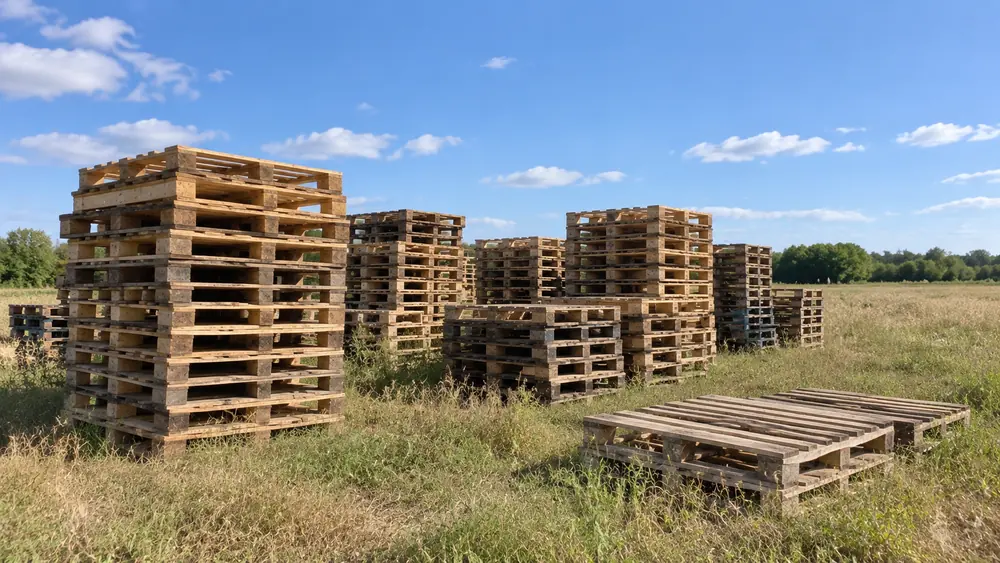
A stringer pallet uses three parallel timbers running the long dimension, with deck boards nailed across them. It is cheap, strong in the right direction, and it has been the North American default for sixty years. Notches cut into the outer stringers give partial four-way entry: a forklift enters from any side, but a pallet jack can only enter the notched sides because its wheels need the full opening.
A block pallet replaces those stringers with nine blocks — four corners, four edge midpoints, one centre — joined by perimeter and interior stringer boards. Entry is genuinely four-way for everything, including pallet jacks. It costs more, weighs two to four pounds more, and behaves far better in automated handling.
Where stringers fail in practice
The classic failure is a pallet jack entering a notch at an angle. The wheels catch the notch edge and tear it out, and because the notch sits in the middle of the stringer's span, the damage is structural rather than cosmetic. We see this constantly in facilities that switched from forklifts to electric jacks without changing their pallet spec.
The second failure is deflection in beam racking. A stringer pallet supported only at its ends sags at the centre because the stringers are loaded in bending across their weak axis. Block pallets with perimeter base boards distribute that load far better, which is why their racked ratings are closer to their dynamic ratings.
Where blocks are overkill
If your operation is forklift-only, floor-stacked, and inside a single building, a Grade A stringer pallet will do everything you need for noticeably less money. Paying for four-way entry you never use is just paying for wood.
Blocks earn their premium in three situations: automated conveyors and AS/RS, pallet-jack-heavy operations, and export where the receiving dock is unknown. In those cases the price difference pays for itself in one avoided jam.
The automation question
Automated systems are unforgiving about dimensional consistency. A conveyor expects the leading edge in a specific place; a robotic shuttle expects a flat bottom. Stringer pallets with plugs, companions or protruding nails will eventually stop a line, and a stopped line costs more per hour than a year of pallet upgrades.
When a customer tells us they are commissioning automation, our first recommendation is always the same: specify block pallets, specify a tolerance in writing, and let us pre-screen every unit against it. We would rather do an extra sorting pass than be the reason a new system gets blamed.
What we stock, and how to decide
We keep deep pools of both in 48×40. Block pallets run one to three days on lead time because the used supply is thinner; stringers are usually same day.
The decision tree is short. Pallet jacks or automation? Block. Forklifts, floor stacking, closed loop? Stringer. Unknown destination dock? Block. Still unsure? Tell us how the pallet gets moved at every point in its journey and we will answer in one email.