Built
Douglas fir from a mill inside 180 miles. Seven top boards, five bottom, three stringers, helical nails, 2,800 lb dynamic.
Request a quote
Ask and we will send the specification set, the carbon methodology or a sample diversion certificate — no form-filling theatre, just an email back.
Portland, OR · email only, no phone
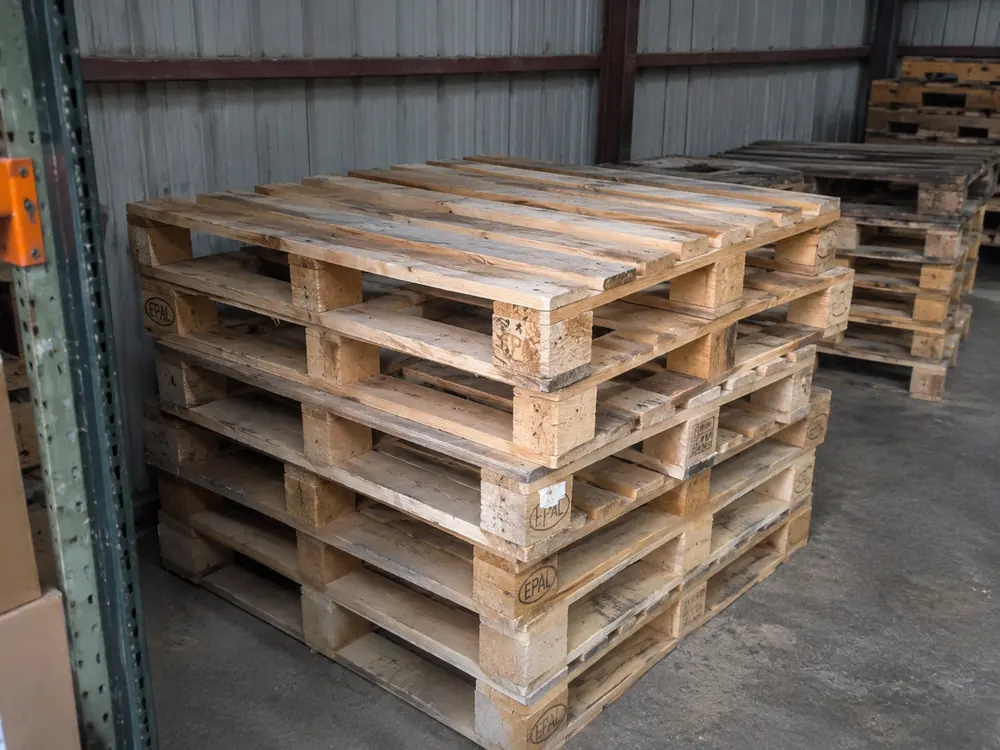
Every pool, every tolerance, every load rating, on one page.
Quoted todaywritten, 1 business day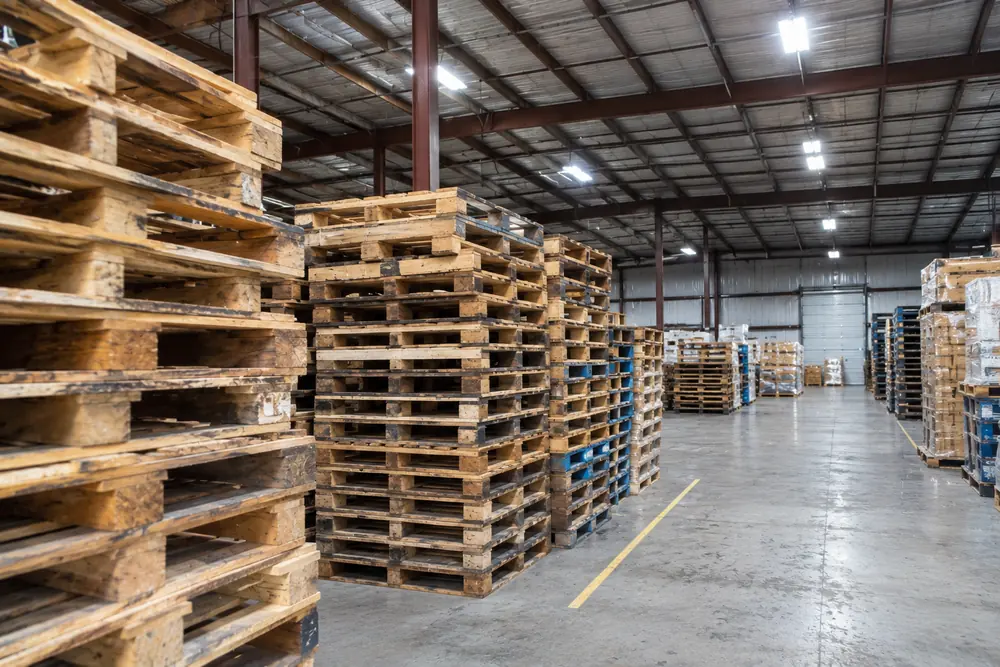
The eleven-minute receiving routine we hand to new customers.
Quoted todaywritten, 1 business day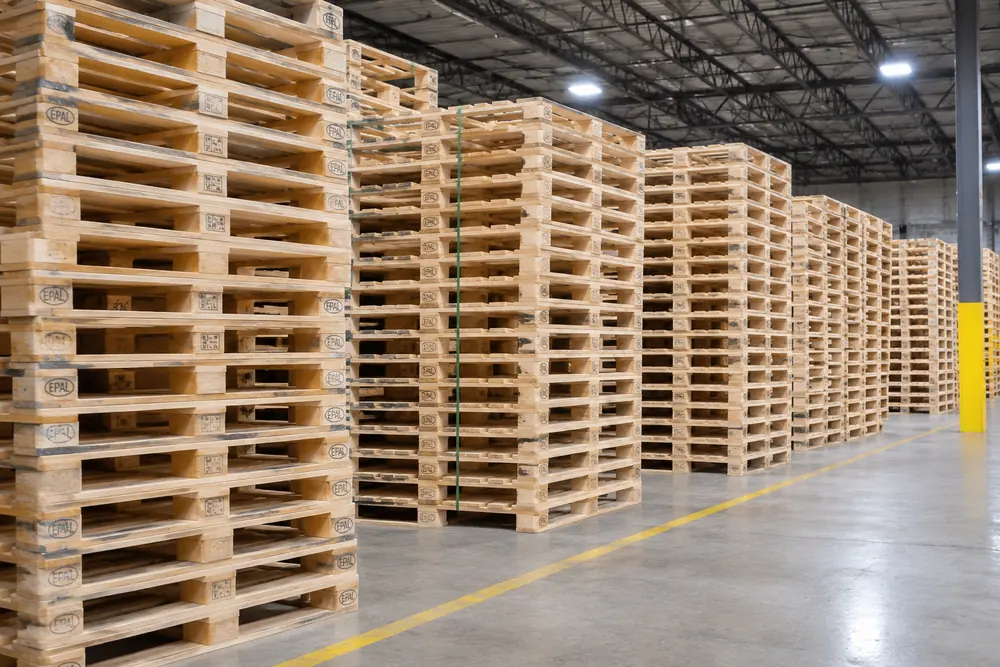
Inches, millimetres, pounds, kilos, board feet and trailer counts.
Quoted todaywritten, 1 business day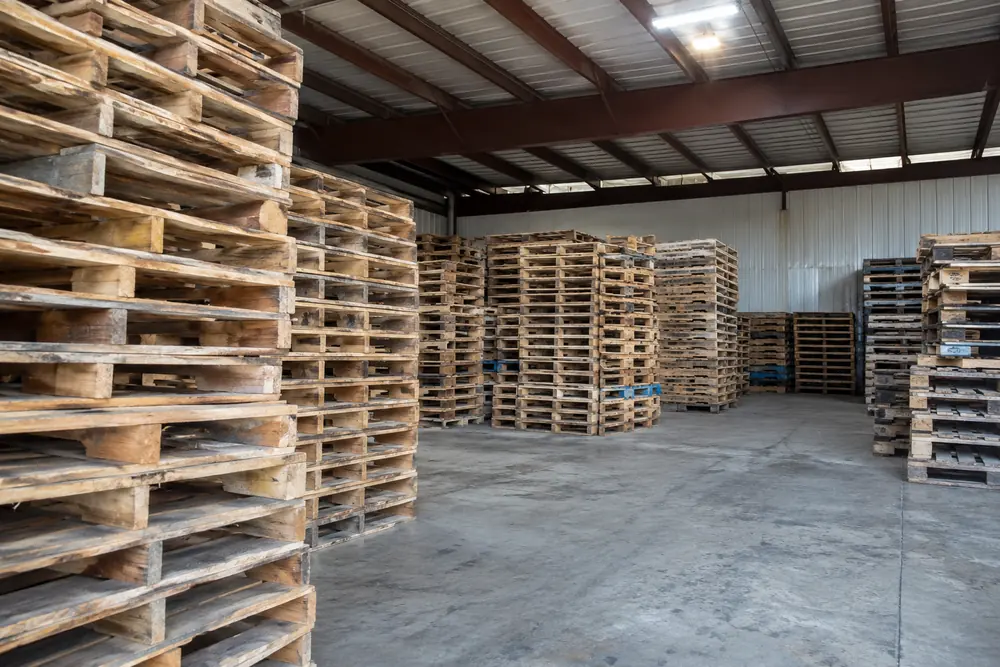
ISPM-15, EPAL, ISO, ASTM, OSHA, FDA, Oregon EPR — who governs what.
Quoted todaywritten, 1 business day| Pallet | Static | Dynamic | Racked | Tare | Stack height |
|---|---|---|---|---|---|
| 48×40 GMA Grade A | 8,000 lb | 2,800 lb | 2,200 lb | 33–37 lb | 3 high loaded |
| 48×40 GMA Grade B | 6,500 lb | 2,200 lb | 1,500 lb | 30–36 lb | 2 high loaded |
| 48×40 block, 4-way | 9,000 lb | 2,500 lb | 2,400 lb | 37–41 lb | 4 high loaded |
| EPAL / Euro 1 | 8,800 lb | 3,300 lb | 2,200 lb | 48–55 lb | 3 high loaded |
| 42×42 beverage | 7,500 lb | 2,600 lb | 1,900 lb | 35–39 lb | 3 high loaded |
| 48×48 drum | 9,500 lb | 3,000 lb | 2,300 lb | 40–45 lb | 2 high loaded |
| 36×36 nursery deck | 4,500 lb | 1,400 lb | 900 lb | 24–28 lb | 2 high loaded |
| 48×20 half pallet | 3,000 lb | 1,400 lb | 900 lb | 18–22 lb | 2 high loaded |
| Remanufactured 48×40 | 6,000 lb | 2,000 lb | 1,200 lb | 30–38 lb | 2 high loaded |
| Heavy skid 96×48 | 16,000 lb | 12,000 lb | Not for racking | 95–130 lb | 1 high |
Receiving
Eleven minutes on the first three deliveries sets the tone for the whole relationship. Do this with any supplier, including us.
| Check | How | Pass | If it fails |
|---|---|---|---|
| Overall size | Tape measure, both dimensions, one pallet in ten | Within 1/4" (Grade A) or 1/2" (Grade B) | Note it on the delivery ticket |
| Squareness | Steel square in two opposite corners | Within 1/4" on the diagonal | Reject the unit; we replace next route |
| Protruding nails | Palm flat across the top deck | Nothing catches | Reject — this is what tears packaging |
| Bottom boards | Flip one pallet in ten | No split through a nail line | Reject; it will fail in a rack |
| Moisture | Lift one. Wet pallets are 8–10 lb heavier | Feels dry, sounds sharp | Floor stack to dry, do not rack at rating |
| Mould or staining | Visual, both decks | Weathering only, no fuzz | Reject for any food-contact use |
| Grade mix | Count against the delivery note | Matches what you ordered | Ask for the count sheet to be corrected |
Write failures on the delivery ticket rather than calling — a written record is the only thing that reliably changes supplier behaviour, and we replace rejected units on the next route with no restocking charge.
Storage
Portland takes about 36 inches of rain a year and most of it lands between November and March. You do not need a building to survive that — you need three habits.
| Condition | Weight | Stiffness | Rack it? |
|---|---|---|---|
| Kiln dried (≤19% MC) | 33 lb | Full rating | Yes |
| Air dried, covered | 35 lb | Full rating | Yes |
| Damp, uncovered 2 weeks | 39 lb | Reduced | Floor stack |
| Rain-soaked | 45 lb | Materially reduced | No — let it dry |
| Frozen wet | 45 lb+ | Unpredictable | No |
Nine pounds of water per pallet is nine pounds of freight you pay to move. Across 600 units that is more than two and a half tonnes of water on a truck. Field notes on moisture
Diagnostics
Damage patterns are not random. Each one points at a specific handling behaviour, and fixing the behaviour is worth more than fixing the pallets.
| What you see | What it almost always means | What to change | Cost to fix |
|---|---|---|---|
| Split lead boards at one end | Forks driven in too fast and too high | Operator training; dock lighting. Usually one shift is responsible | Free |
| Torn stringer notches | Pallet jacks entering notched stringers at an angle | Specify block pallets with true four-way entry | Spec change |
| Bottom boards ripped off cleanly | Pallets dragged rather than lifted, or frozen to a cold-store floor | Floor condition, forklift capacity at peak | Low |
| Crushed corner blocks | Stacks higher than the rating, or uneven loads on one corner | Stack-height policy; centre the load | Free |
| Out of square, nothing broken | Racking loading pallets diagonally — beams at different heights | Rack survey. This one is worth chasing | Medium |
| Mould in the middle of a stack | Wet pallets stacked tight with no airflow | Store off the ground, cover the top, leave side gaps | Low |
| Protruding nails tearing cases | Ungraded stock, or units repaired without re-checking | Buy graded; reject on the ticket | Free |
| Deck boards cupping | Moisture cycling between a freezer and a humid dock | Kiln-dried pool; helical fasteners | Spec change |
Keep thirty of your own broken pallets aside for a month and photograph the damage. Patterns appear quickly. We do this analysis free with any repair quote, because a customer whose damage rate halves buys from us for a decade.
If you are selling
None of these require you to sort anything. They just make the pile faster for a driver and a grader to deal with, and that difference lands in the price.
The bottom layer of a stack sitting on soil is the layer we have to write off. Two spare pallets underneath prevents it.
Even stacks load faster, count accurately and travel without shifting. Leaning piles get counted conservatively.
You do not need to grade, but separating 48×40 from everything else takes minutes and raises the per-unit price.
Carpet, foam-backed board, metal frames and the occasional bicycle. Composites cost us money to separate.
A pile behind a locked gate at the end of a narrow alley is worth less than the same pile on a loading apron.
One picture from fifteen feet tells a grader footprint, grade mix, moisture exposure and count within about 15%.
| Material | We take it | Basis |
|---|---|---|
| 48×40 GMA, any grade | Yes | Paid per unit by grade |
| Euro / EPAL branded | Yes | Paid per unit, market dependent |
| Block pallets, odd sizes | Yes | Paid per unit |
| Broken cores, mixed piles | Yes | Usually collected free |
| Crates, bins, dunnage | Yes | By weight |
| Wet or unsortable stock | Yes | Free, or a small haul fee |
| Marked rental-pool pallets | No | They belong to their operator |
| MB-stamped (fumigated) | No | Cannot enter our streams |
| Painted or contaminated | No | Would degrade mulch and bedding |
| Fire-damaged | No | Unsafe to process |
Freight
Pallet counts per vehicle and container, so you can sanity-check a quote before you accept it.
| Equipment | Floor positions (48×40) | Empty pallets stacked | Notes |
|---|---|---|---|
| 53' dry van | 30 | up to ~560 | The standard North American trailer |
| 48' dry van | 26 | up to ~500 | Still common on regional lanes |
| 48' flatbed | 26 | up to ~520 | Our workhorse for yard-to-yard moves |
| 53' curtain-sider | 30 | up to ~560 | Weather protection with side access |
| 26' box truck, lift-gate | 12 | up to ~240 | Urban docks with no forklift |
| 40' ocean container | 20 | up to ~400 | ISPM-15 marking required |
| 40' high-cube container | 20 | up to ~460 | Extra height, same floor |
| 20' ocean container | 10 | up to ~200 | Heavy, dense loads |
| 40 yd hook-lift container | n/a | ~90 loose cores | For standing recycling bins |
Pallet freight is almost always weight-constrained before it is cube-constrained, which is why tare weight is a real cost line. How we price a lane
Worked example
A real comparison for a plant shipping 600 pallets a month on a weight-sensitive lane. Copy the method, not the numbers.
| Line | New pallet | Grade A recycled | Grade B recycled | Note |
|---|---|---|---|---|
| Unit purchase price (index) | 100 | 50 | 35 | The only number most procurement systems compare |
| Trips before repair | 15–20 | 9–14 | 7–11 | New lasts longer; it also costs twice as much |
| Purchase cost per trip (index) | 5.6 | 4.3 | 3.8 | Price divided by trips |
| Tare weight | 36 lb | 35 lb | 33 lb | Recycled fir is often lighter than new hardwood |
| Freight weight penalty | Baseline | Neutral | −3 lb/unit | Only matters on weight-limited lanes |
| Expected damage rate | 0.3% | 0.3% | 0.4% | Graded stock behaves; ungraded stock does not |
| Receiving rejections | Rare | Rare | Occasional | Graded + written tolerance removes most of this |
| End-of-life cost | 0 | 0 | 0 | We collect and pay or collect free — never a disposal fee |
| Documentation value | None | Diversion certificate | Diversion certificate | Reportable ESG outcome at no extra cost |
Build this yourself
One row per option, six columns: unit price, tare weight, expected trips, damage rate, rejection risk, disposal cost. Multiply out across annual volume. It takes an afternoon, the cheapest unit price almost never wins, and we will happily help build it — including with numbers that do not favour us.
The full articleDecision table
Including the two we do not sell. Cost index is against a new wooden pallet of the same footprint.
| Option | Cost index | Trips | Repairable | Carbon per use | Best for | Watch out for |
|---|---|---|---|---|---|---|
| Grade A recycled | 45–55 | 9–14 then repair | Yes | 3.1 kg | Almost everything | Colour varies; tare varies by a few pounds |
| Grade B recycled | 30–40 | 7–11 then repair | Yes | 3.1 kg | One-way, floor stacking, closed loops | Lower racked rating (1,500 lb) |
| Remanufactured | 25–35 | 5–8 | Yes | 4.8 kg | One-way on a budget | Visibly mixed boards; 1,200 lb racked |
| New wooden | 100 | 15–20 then repair | Yes | 14.2 kg | Tight tolerances, audits, odd sizes | Pays for appearance you may not need |
| Plastic | 500–1,000 | 30–100 | No | High embodied, low per-use | Wash-down, deep freeze, pharma | Cracks end its life; not repairable |
| Rental pool | Per-trip fee | Managed | By operator | Operator's figure | Exchange networks, retail mandates | Pallets are not yours; losses are chargeable |
We sell the first four and supply plastic where a wash-down line genuinely needs it. We do not operate a rental pool, and we will not buy marked pool pallets from you — they belong to their operator. Full comparisons
Timing
Supply and price both move with the seasons. Knowing the shape of the year is worth more than negotiating hard in October.
| Month | What the region is doing | Pool depth | What to do |
|---|---|---|---|
| January | Everything quiet; recycling inflow steady | Deep | Best buying window of the year. We stockpile now |
| February | Repair bay catching up | Deep | Lock quarterly pricing; book spring nursery stock |
| March | Nursery season begins | Tightening on 36×36 | Spring stock should already be reserved |
| April | Nursery peak; landscaping starts | Tight on nursery decks | Mulch and bedding demand rises sharply |
| May | Nursery winding down | Normalising | Good month for custom builds and crate projects |
| June | Berry harvest | Normal | Watch for short-notice agricultural requests |
| July | Berries, early stone fruit | Normal | Forecast your October number now |
| August | Pre-harvest build-up | Normalising down | Harvest slots allocated this month |
| September | Hazelnut and grape harvest begins | Tight | Reserved stock only. Spot buyers struggle |
| October | Peak harvest; cider apples | Tightest of the year | Do not start here. Everyone calls at once |
| November | Harvest ends; rain begins | Recovering | Grading gets stricter; covered storage fills |
| December | Retail peak, agriculture stops | Deep again | Mulch demand collapses, biomass rises |
Safety
OSHA 1910.176 covers storage and housekeeping in your building. These are the specifics that actually cause incidents.
If nobody can produce a racked (edge-support) figure in writing, treat the pallet as unrated and floor stack it. This is the single most common serious incident in warehousing.
Keep empty pallet stacks to a sensible, stable height — commonly capped around 15 units or 6 feet by site policy — on level ground, away from exits and sprinkler heads.
Idle wooden pallets burn fast and hot. Most fire codes limit indoor idle storage and require separation from other combustibles. Outdoor storage needs clearance from buildings.
Obvious, routinely ignored, and the cause of most pallet-related injuries. Use equipment, not a foothold.
Gloves, and reject units with nails standing proud. A nail that tears a case will also tear a hand.
Never burn MB-fumigated, painted or chemically treated wood. Untreated offcuts are fine as fuel; everything else goes to a proper stream.
This is general guidance rather than a compliance document. Your local fire code and your own risk assessment govern; we are happy to supply load ratings and treatment records to support yours.
Reference
Pallets sit under a surprising number of overlapping rules. Here is who writes them and what they actually govern.
| Reference | Who maintains it | What it governs | Does it bind a used pallet sale? |
|---|---|---|---|
| ISPM-15 | IPPC, under the UN FAO | Treatment and marking of solid wood packaging in international trade | Yes, for export |
| GMA footprint (48×40) | Industry convention, originally grocery manufacturers | A footprint, not a quality level | No — it is a size |
| EPAL / EUR | European Pallet Association | Euro pallet construction, repair and branding | Yes, if sold as EPAL |
| ISO 6780 | International Organization for Standardization | Principal pallet footprints worldwide | No |
| ASTM D1185 / D1083 | ASTM International | Test methods for pallet performance | No, but ratings reference them |
| PDS (Pallet Design System) | Virginia Tech / NWPCA | Engineering-grade load modelling | No — a design tool |
| NWPCA uniform standards | National Wooden Pallet & Container Association | Common grade vocabulary | Voluntary |
| OSHA 1910.176 | US Dept of Labor | Safe storage, stacking and housekeeping | Yes, in your building |
| Oregon EPR (SB 582) | Oregon DEQ | Producer responsibility for packaging; wood is in scope for reporting | Increasingly, yes |
| FSMA / food safety plans | US FDA | Packaging as a food-contact hazard consideration | Via your audit, yes |
The gap in that list is the interesting part: no authority grades used pallets. That is why a written supplier specification — ours is published here — is the entire quality system in this industry.
Lifecycle
A composite built from real Passport records. Individual units vary enormously; the shape does not.
Douglas fir from a mill inside 180 miles. Seven top boards, five bottom, three stringers, helical nails, 2,800 lb dynamic.
Beverage route work. Loaded, racked, unloaded, returned. Colour starts to grey; nothing structural changes.
A lead board splits at a nail line. Twenty-minute fix: replacement deck board, re-square, re-stamp. Graded B from here.
Nursery and agricultural work, where deck gaps matter more than appearance. Spends two winters partly outdoors.
A stringer cracks. A second timber is fitted alongside, spanning the crack. Measurably stiffer than before.
Local one-way freight. Tare weight has drifted up a pound from accumulated moisture cycling.
Two bottom boards gone, deck softening. Economic repair ends here. Chalk line through the whole pallet.
De-nailed board by board. Clear boards to the fabrication shop; structural stock back to the repair bay as donor material.
What is left goes through a magnet and a grinder: mulch, bedding shavings, biomass fuel. The nails go to a scrap partner four miles away.
The best boards are now shelving in a bottle shop, carrying its Passport ID burned into the end grain.
Thirteen trips, two repairs, roughly 143 kg CO₂e avoided against building thirteen new pallets, and nothing landfilled at the end. Look up a real record
Vocabulary
Defined the way a yard uses them, not the way a standards document does.
Questions
No hard minimum for collection at the yard — come and take four pallets on a Saturday morning if you like. For delivery it is 50 units inside Portland metro and 150 outside it, because the truck has to earn its diesel. Outside our 180-mile fleet radius we quote through partner yards and freight, with the lane itemised.
Standard 48×40 Grade A and B stock: same day for pickup, next day for metro delivery. Block pallets one to three days. Custom builds five to nine business days; engineered runs two to three weeks. Heat treatment is same day for booked batches and 48 hours standard. Written quotes always come back within one business day.
Because verbal quotes get remembered differently by different people. Since 2018 every price, date and commitment we make exists in an email you can search and forward. Most customers dislike it for about a month and then prefer it. Everything else happens in person at 3821 NW St Helens Rd, Portland, OR 97210.
Please do. Visit the yard by email arrangement — closed-toe boots required, hi-vis provided — or ask for photographs of the actual pool your order would come from. We would rather lose an order than have a customer discover a surprise on their dock.
A written quote, a signed count sheet by grade, a weight ticket where material is weighed, heat-treatment certificates for treated batches (archived seven years), and a monthly diversion certificate for anything we collect for recycling — measured pounds kept out of landfill, which is the figure your ESG report actually needs.
Take methyl-bromide fumigated, chemically contaminated or fire-damaged wood. Buy marked rental-pool pallets, which belong to their operator. Promise same-day delivery outside the metro. Or quote a grade we do not think will survive your handling — we will specify downward and explain why.
Long reads
Forty terms you will hear from a pallet yard, defined in the way a yard actually uses them rather than the way a standar…
There is no federal pallet grading authority. There is only what each yard writes down and whether they honour it. Here …
A soaked pallet can lose a quarter of its stiffness, gain nine pounds, and transfer mould to your packaging. In Oregon t…
A robot has no judgement. Every tolerance you used to absorb with a human operator becomes a line item in a spec sheet.…
Deeper
Next step
All of it is published precisely so it can be referenced in a contract rather than argued about afterwards.