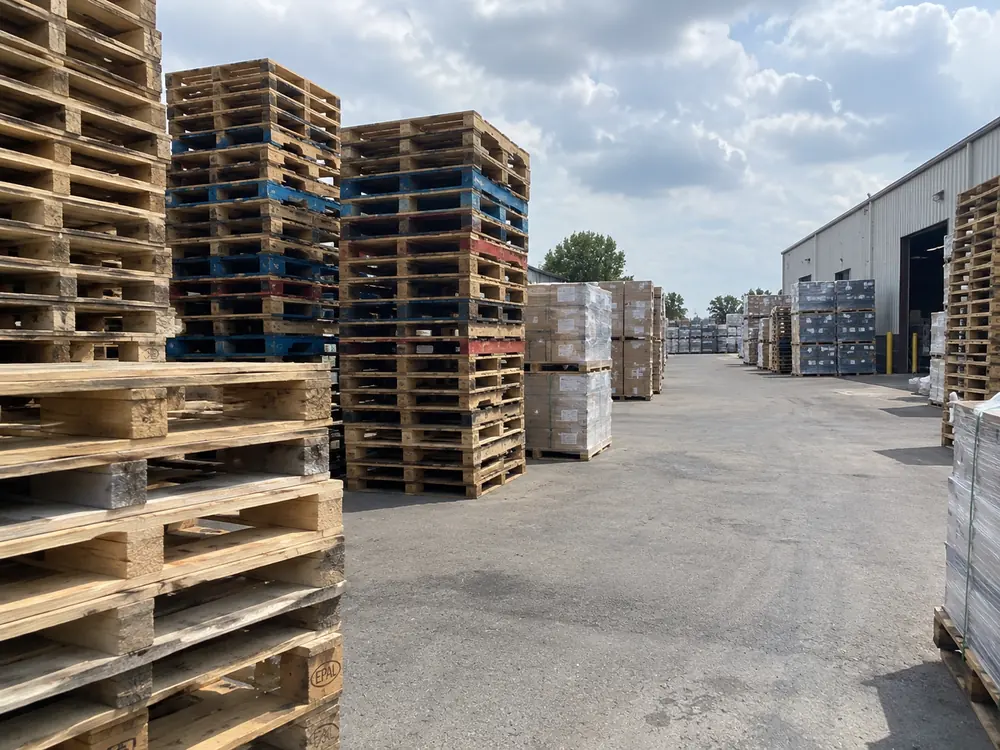
The yard
PalletLinker LLC3821 NW St Helens RdPortland, OR 97210USAFour acres between the railway and the river in northwest industrial Portland. Visits welcome by email arrangement — closed-toe boots required, hi-vis provided.
Tour the yardRequest a quote
One business day for a written reply. Required fields are validated before anything is sent, so a typo in your email or ZIP gets flagged rather than swallowed.
Portland, OR · email only, no phone
Four acres between the railway and the river in northwest industrial Portland. Visits welcome by email arrangement — closed-toe boots required, hi-vis provided.
Tour the yardGeneral, visits, careers, anything unclear.
Quotes, availability, supply programs.
Pickups, recycling, selling us your pile.
All three reach people in the yard. Nothing routes to an answering service, because there is not one.
Email is read outside these hours too, but nothing gets loaded onto a truck until somebody is at the scale.
Practicalities
Process
No sales team, no discovery call, no CRM sequence. We have no telephone, so everything below happens in writing and stays searchable afterwards.
Every form on this site is the same form and reaches the same yard team. Required fields are validated as you type, so a mistyped ZIP or email is caught before anything is sent.
Used pallet availability moves daily. You get a real count and a real date rather than a list price that was true last quarter.
Price per unit by grade, freight itemised separately, delivery window, and any honest reservations we have about the specification you asked for.
Signed count sheet on arrival, weight ticket where relevant, and a diversion certificate for anything we collect for recycling.
Questions
No hard minimum for collection at the yard — come and take four pallets on a Saturday morning if you like. For delivery it is 50 units inside Portland metro and 150 outside it, because the truck has to earn its diesel. Outside our 180-mile fleet radius we quote through partner yards and freight, with the lane itemised.
Standard 48×40 Grade A and B stock: same day for pickup, next day for metro delivery. Block pallets one to three days. Custom builds five to nine business days; engineered runs two to three weeks. Heat treatment is same day for booked batches and 48 hours standard. Written quotes always come back within one business day.
Because verbal quotes get remembered differently by different people. Since 2018 every price, date and commitment we make exists in an email you can search and forward. Most customers dislike it for about a month and then prefer it. Everything else happens in person at 3821 NW St Helens Rd, Portland, OR 97210.
Please do. Visit the yard by email arrangement — closed-toe boots required, hi-vis provided — or ask for photographs of the actual pool your order would come from. We would rather lose an order than have a customer discover a surprise on their dock.
A written quote, a signed count sheet by grade, a weight ticket where material is weighed, heat-treatment certificates for treated batches (archived seven years), and a monthly diversion certificate for anything we collect for recycling — measured pounds kept out of landfill, which is the figure your ESG report actually needs.
Take methyl-bromide fumigated, chemically contaminated or fire-damaged wood. Buy marked rental-pool pallets, which belong to their operator. Promise same-day delivery outside the metro. Or quote a grade we do not think will survive your handling — we will specify downward and explain why.
If you are selling
None of these require you to sort anything. They just make the pile faster for a driver and a grader to deal with, and that difference lands in the price.
The bottom layer of a stack sitting on soil is the layer we have to write off. Two spare pallets underneath prevents it.
Even stacks load faster, count accurately and travel without shifting. Leaning piles get counted conservatively.
You do not need to grade, but separating 48×40 from everything else takes minutes and raises the per-unit price.
Carpet, foam-backed board, metal frames and the occasional bicycle. Composites cost us money to separate.
A pile behind a locked gate at the end of a narrow alley is worth less than the same pile on a loading apron.
One picture from fifteen feet tells a grader footprint, grade mix, moisture exposure and count within about 15%.
| Material | We take it | Basis |
|---|---|---|
| 48×40 GMA, any grade | Yes | Paid per unit by grade |
| Euro / EPAL branded | Yes | Paid per unit, market dependent |
| Block pallets, odd sizes | Yes | Paid per unit |
| Broken cores, mixed piles | Yes | Usually collected free |
| Crates, bins, dunnage | Yes | By weight |
| Wet or unsortable stock | Yes | Free, or a small haul fee |
| Marked rental-pool pallets | No | They belong to their operator |
| MB-stamped (fumigated) | No | Cannot enter our streams |
| Painted or contaminated | No | Would degrade mulch and bedding |
| Fire-damaged | No | Unsafe to process |
Freight
Pallet counts per vehicle and container, so you can sanity-check a quote before you accept it.
| Equipment | Floor positions (48×40) | Empty pallets stacked | Notes |
|---|---|---|---|
| 53' dry van | 30 | up to ~560 | The standard North American trailer |
| 48' dry van | 26 | up to ~500 | Still common on regional lanes |
| 48' flatbed | 26 | up to ~520 | Our workhorse for yard-to-yard moves |
| 53' curtain-sider | 30 | up to ~560 | Weather protection with side access |
| 26' box truck, lift-gate | 12 | up to ~240 | Urban docks with no forklift |
| 40' ocean container | 20 | up to ~400 | ISPM-15 marking required |
| 40' high-cube container | 20 | up to ~460 | Extra height, same floor |
| 20' ocean container | 10 | up to ~200 | Heavy, dense loads |
| 40 yd hook-lift container | n/a | ~90 loose cores | For standing recycling bins |
Pallet freight is almost always weight-constrained before it is cube-constrained, which is why tare weight is a real cost line. How we price a lane
Timing
Supply and price both move with the seasons. Knowing the shape of the year is worth more than negotiating hard in October.
| Month | What the region is doing | Pool depth | What to do |
|---|---|---|---|
| January | Everything quiet; recycling inflow steady | Deep | Best buying window of the year. We stockpile now |
| February | Repair bay catching up | Deep | Lock quarterly pricing; book spring nursery stock |
| March | Nursery season begins | Tightening on 36×36 | Spring stock should already be reserved |
| April | Nursery peak; landscaping starts | Tight on nursery decks | Mulch and bedding demand rises sharply |
| May | Nursery winding down | Normalising | Good month for custom builds and crate projects |
| June | Berry harvest | Normal | Watch for short-notice agricultural requests |
| July | Berries, early stone fruit | Normal | Forecast your October number now |
| August | Pre-harvest build-up | Normalising down | Harvest slots allocated this month |
| September | Hazelnut and grape harvest begins | Tight | Reserved stock only. Spot buyers struggle |
| October | Peak harvest; cider apples | Tightest of the year | Do not start here. Everyone calls at once |
| November | Harvest ends; rain begins | Recovering | Grading gets stricter; covered storage fills |
| December | Retail peak, agriculture stops | Deep again | Mulch demand collapses, biomass rises |
Next step
Scroll back up, or use the floating button in the corner — it opens the same form in a full-screen window.