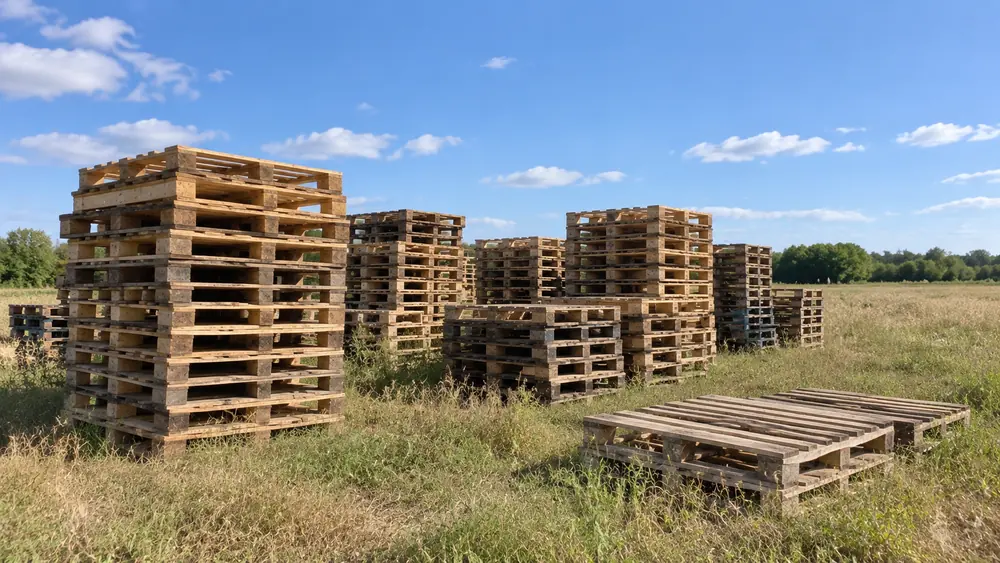
Built
Douglas fir from a mill inside 180 miles. Seven top boards, five bottom, three stringers, helical nails, 2,800 lb dynamic.
Request a quote
Select the recycling service below and tell us your volume. We will send a sample certificate and the full carbon methodology as a PDF.
Portland, OR · email only, no phone
Comparison
Modelled kg CO₂e per 48×40 pallet. Lower is better; the difference between the first and last line is the entire business.
Three pages, no hand-waving
Six stations — collect, grade, repair, reuse, remake, recover — and where circularity actually breaks.
Read moreThe full derivation of 11 kg CO₂e, line by line, including displacement leakage.
Read moreOne sentence, no exemptions, and the three awkward cases that cost us money.
Read more“A number without its assumptions is marketing. We would rather publish a smaller defensible figure than a larger one we cannot stand behind in an audit.”
Reuse is the cheapest emissions reduction available in logistics, and it is also the easiest to document. We model a new 48×40 softwood pallet at 14.2 kg CO₂e — lumber production, fasteners, assembly and delivery — and a reuse cycle at 3.1 kg, covering collection, repair materials, yard overhead and redelivery. The difference, 11 kg CO₂e per reuse, is the figure we publish.
We also publish the caveat: that figure assumes a reused pallet genuinely displaces the manufacture of a new one. Economists call the gap leakage, and nobody in this industry can honestly claim it is zero. We think displacement is high because the pallet market is regional and price-responsive, but we will not pretend it is perfect.
Which is why we lead with the number that needs no assumptions: measured landfill diversion. Landfilled wood decomposes anaerobically and releases methane, roughly 28 times worse than CO₂ over a century. Keeping four million pounds of wood out of a hole in the ground is a benefit you can weigh.
Per-unit figures
Process
No sales team, no discovery call, no CRM sequence. We have no telephone, so everything below happens in writing and stays searchable afterwards.
Every form on this site is the same form and reaches the same yard team. Required fields are validated as you type, so a mistyped ZIP or email is caught before anything is sent.
Used pallet availability moves daily. You get a real count and a real date rather than a list price that was true last quarter.
Price per unit by grade, freight itemised separately, delivery window, and any honest reservations we have about the specification you asked for.
Signed count sheet on arrival, weight ticket where relevant, and a diversion certificate for anything we collect for recycling.
Questions
No hard minimum for collection at the yard — come and take four pallets on a Saturday morning if you like. For delivery it is 50 units inside Portland metro and 150 outside it, because the truck has to earn its diesel. Outside our 180-mile fleet radius we quote through partner yards and freight, with the lane itemised.
Standard 48×40 Grade A and B stock: same day for pickup, next day for metro delivery. Block pallets one to three days. Custom builds five to nine business days; engineered runs two to three weeks. Heat treatment is same day for booked batches and 48 hours standard. Written quotes always come back within one business day.
Because verbal quotes get remembered differently by different people. Since 2018 every price, date and commitment we make exists in an email you can search and forward. Most customers dislike it for about a month and then prefer it. Everything else happens in person at 3821 NW St Helens Rd, Portland, OR 97210.
Please do. Visit the yard by email arrangement — closed-toe boots required, hi-vis provided — or ask for photographs of the actual pool your order would come from. We would rather lose an order than have a customer discover a surprise on their dock.
A written quote, a signed count sheet by grade, a weight ticket where material is weighed, heat-treatment certificates for treated batches (archived seven years), and a monthly diversion certificate for anything we collect for recycling — measured pounds kept out of landfill, which is the figure your ESG report actually needs.
Take methyl-bromide fumigated, chemically contaminated or fire-damaged wood. Buy marked rental-pool pallets, which belong to their operator. Promise same-day delivery outside the metro. Or quote a grade we do not think will survive your handling — we will specify downward and explain why.
Vocabulary
Defined the way a yard uses them, not the way a standards document does.
Long reads
Roughly half the dry weight of wood is carbon. Keeping that carbon in a working object for twenty years is a climate str…
We publish a figure of roughly 11 kg CO₂e avoided per reused pallet. Here is every assumption behind that number, includ…
Delivering loaded pallets and leaving with empties halves the truck movements. The hard part is not the idea; it is the …
Four products come out of a pallet that failed its last inspection, and one of them ends up as a café counter in St John…
Lifecycle
A composite built from real Passport records. Individual units vary enormously; the shape does not.
Douglas fir from a mill inside 180 miles. Seven top boards, five bottom, three stringers, helical nails, 2,800 lb dynamic.
Beverage route work. Loaded, racked, unloaded, returned. Colour starts to grey; nothing structural changes.
A lead board splits at a nail line. Twenty-minute fix: replacement deck board, re-square, re-stamp. Graded B from here.
Nursery and agricultural work, where deck gaps matter more than appearance. Spends two winters partly outdoors.
A stringer cracks. A second timber is fitted alongside, spanning the crack. Measurably stiffer than before.
Local one-way freight. Tare weight has drifted up a pound from accumulated moisture cycling.
Two bottom boards gone, deck softening. Economic repair ends here. Chalk line through the whole pallet.
De-nailed board by board. Clear boards to the fabrication shop; structural stock back to the repair bay as donor material.
What is left goes through a magnet and a grinder: mulch, bedding shavings, biomass fuel. The nails go to a scrap partner four miles away.
The best boards are now shelving in a bottle shop, carrying its Passport ID burned into the end grain.
Thirteen trips, two repairs, roughly 143 kg CO₂e avoided against building thirteen new pallets, and nothing landfilled at the end. Look up a real record
Decision table
Including the two we do not sell. Cost index is against a new wooden pallet of the same footprint.
| Option | Cost index | Trips | Repairable | Carbon per use | Best for | Watch out for |
|---|---|---|---|---|---|---|
| Grade A recycled | 45–55 | 9–14 then repair | Yes | 3.1 kg | Almost everything | Colour varies; tare varies by a few pounds |
| Grade B recycled | 30–40 | 7–11 then repair | Yes | 3.1 kg | One-way, floor stacking, closed loops | Lower racked rating (1,500 lb) |
| Remanufactured | 25–35 | 5–8 | Yes | 4.8 kg | One-way on a budget | Visibly mixed boards; 1,200 lb racked |
| New wooden | 100 | 15–20 then repair | Yes | 14.2 kg | Tight tolerances, audits, odd sizes | Pays for appearance you may not need |
| Plastic | 500–1,000 | 30–100 | No | High embodied, low per-use | Wash-down, deep freeze, pharma | Cracks end its life; not repairable |
| Rental pool | Per-trip fee | Managed | By operator | Operator's figure | Exchange networks, retail mandates | Pallets are not yours; losses are chargeable |
We sell the first four and supply plastic where a wash-down line genuinely needs it. We do not operate a rental pool, and we will not buy marked pool pallets from you — they belong to their operator. Full comparisons
Worked example
A real comparison for a plant shipping 600 pallets a month on a weight-sensitive lane. Copy the method, not the numbers.
| Line | New pallet | Grade A recycled | Grade B recycled | Note |
|---|---|---|---|---|
| Unit purchase price (index) | 100 | 50 | 35 | The only number most procurement systems compare |
| Trips before repair | 15–20 | 9–14 | 7–11 | New lasts longer; it also costs twice as much |
| Purchase cost per trip (index) | 5.6 | 4.3 | 3.8 | Price divided by trips |
| Tare weight | 36 lb | 35 lb | 33 lb | Recycled fir is often lighter than new hardwood |
| Freight weight penalty | Baseline | Neutral | −3 lb/unit | Only matters on weight-limited lanes |
| Expected damage rate | 0.3% | 0.3% | 0.4% | Graded stock behaves; ungraded stock does not |
| Receiving rejections | Rare | Rare | Occasional | Graded + written tolerance removes most of this |
| End-of-life cost | 0 | 0 | 0 | We collect and pay or collect free — never a disposal fee |
| Documentation value | None | Diversion certificate | Diversion certificate | Reportable ESG outcome at no extra cost |
Build this yourself
One row per option, six columns: unit price, tare weight, expected trips, damage rate, rejection risk, disposal cost. Multiply out across annual volume. It takes an afternoon, the cheapest unit price almost never wins, and we will happily help build it — including with numbers that do not favour us.
The full articleReference
Pallets sit under a surprising number of overlapping rules. Here is who writes them and what they actually govern.
| Reference | Who maintains it | What it governs | Does it bind a used pallet sale? |
|---|---|---|---|
| ISPM-15 | IPPC, under the UN FAO | Treatment and marking of solid wood packaging in international trade | Yes, for export |
| GMA footprint (48×40) | Industry convention, originally grocery manufacturers | A footprint, not a quality level | No — it is a size |
| EPAL / EUR | European Pallet Association | Euro pallet construction, repair and branding | Yes, if sold as EPAL |
| ISO 6780 | International Organization for Standardization | Principal pallet footprints worldwide | No |
| ASTM D1185 / D1083 | ASTM International | Test methods for pallet performance | No, but ratings reference them |
| PDS (Pallet Design System) | Virginia Tech / NWPCA | Engineering-grade load modelling | No — a design tool |
| NWPCA uniform standards | National Wooden Pallet & Container Association | Common grade vocabulary | Voluntary |
| OSHA 1910.176 | US Dept of Labor | Safe storage, stacking and housekeeping | Yes, in your building |
| Oregon EPR (SB 582) | Oregon DEQ | Producer responsibility for packaging; wood is in scope for reporting | Increasingly, yes |
| FSMA / food safety plans | US FDA | Packaging as a food-contact hazard consideration | Via your audit, yes |
The gap in that list is the interesting part: no authority grades used pallets. That is why a written supplier specification — ours is published here — is the entire quality system in this industry.
Next step
Monthly certificates with measured diversion weight, reuse rate and CO₂e avoided — per site, audit-ready, and derived from a method you can read in full.