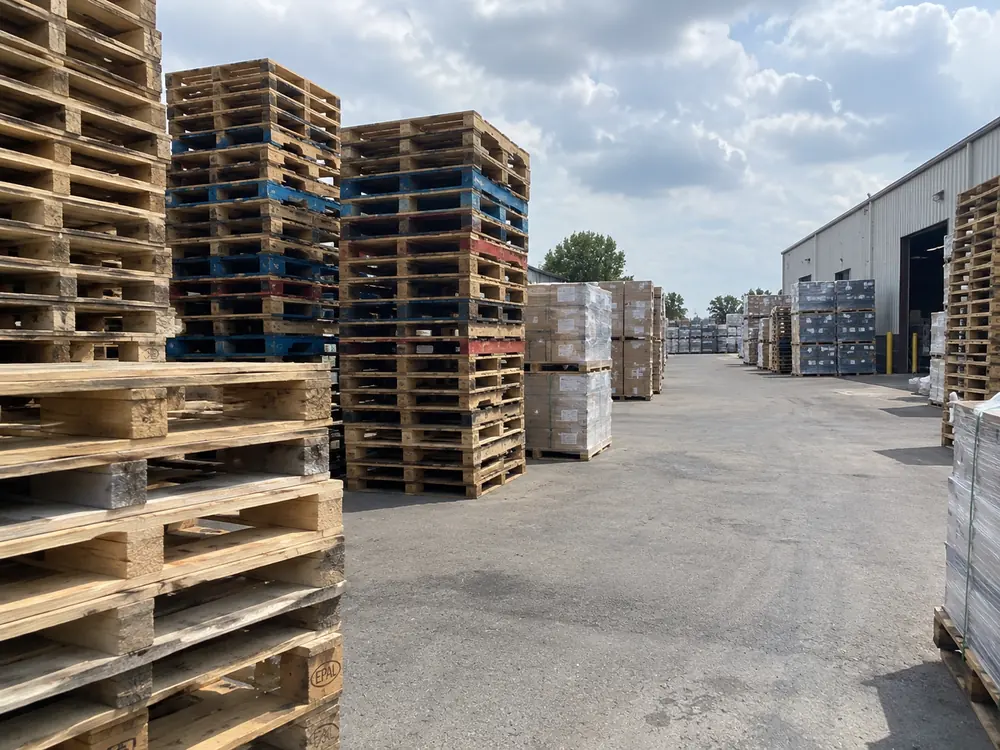
The last inspection
A pallet reaches the end of its carrying life when a stringer is cracked through at a nail line, more than two bottom boards are gone, the deck is soft with rot, or it is out of square beyond half an inch on the diagonal. At that point repair costs more than the pallet is worth.
It is not waste, though. A dead 48×40 pallet still contains 33 pounds of Douglas fir that grew for several decades. The question is only what shape that fibre takes next.
Dismantling, board by board
The de-nailer separates deck boards from stringers and pulls the fasteners. What comes off the machine gets sorted by eye into three piles: clear boards with good grain and no splits, structural stock suitable for repair work, and residual fibre.
Clear boards are the prize. A deck board that spent a decade under cider cases has a colour you cannot buy new, and once it is planed it is furniture-grade material.
Four products, one pallet
Clear boards go to the fabrication shop and become shelving, counters, cladding, retail fixtures and planters. Structural stock goes back to the repair bay as companion stringers and replacement decking. Everything else goes through a magnet and a grinder.
Out of the grinder come three graded streams: single-ground mulch at two-inch minus, double-ground at three-quarter-inch minus for landscaping beds, and kiln-dry flake shavings for animal bedding. Residual fines become biomass fuel chips for regional boilers.
Why the magnet matters more than the grinder
Mulch with metal in it is a liability. A single nail fragment in a landscaping bed near a school is a problem nobody wants to own. We run magnetic separation to a 99.9% standard and spot-check output with a handheld detector.
This is also why we refuse painted and chemically treated wood. A mulch stream is only as trustworthy as its dirtiest input, and we sell that mulch to people who spread it where children play.
The café counter
The piece of this I like most is in a coffee shop in St Johns. The wall cladding behind the espresso machine was a hazelnut-dryer pallet that worked the valley for eleven years. The owner tells customers about it before she tells them about the coffee.
That pallet's Passport ID is burned into the end of one board, at eye height, deliberately. Somebody reading this can go and look it up.