Skip to content
MenuClose
PalletLinker

Our story / people

Six people and four acres

There is no sales team. Every quote, every grade decision and every awkward caveat comes from somebody on this page, which is also why nothing here is written in marketing language.

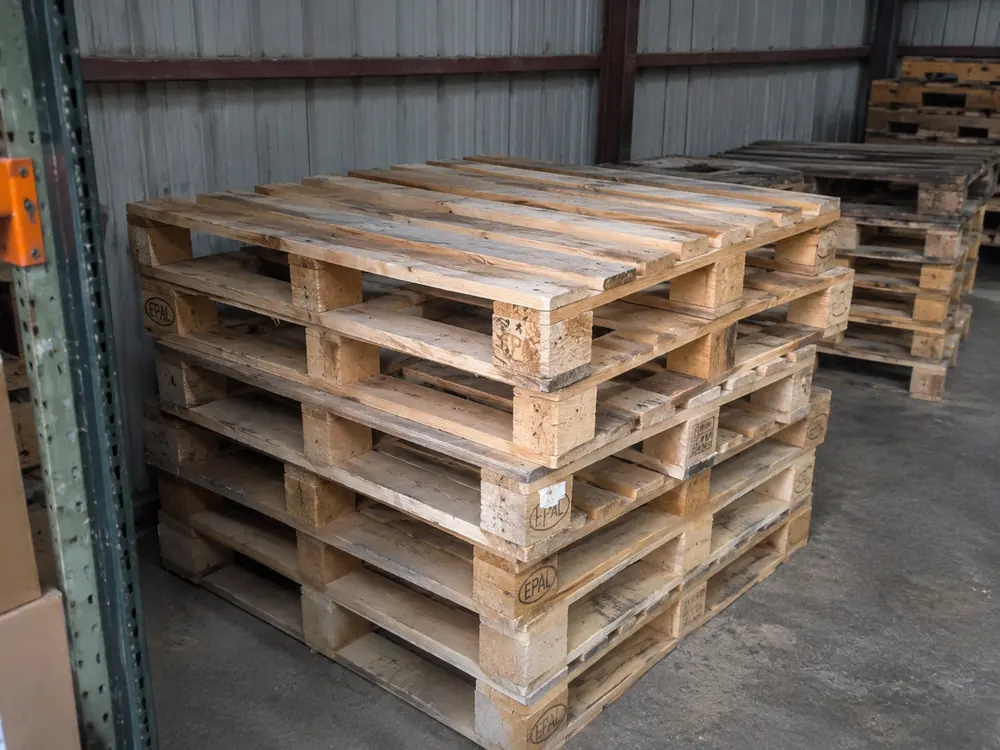
Close view of a single stack of stringer pallets showing deck boards and stamps
48×40 stringer, stamped

Request a quote

Writing to us reaches one of these six.

Not a shared inbox staffed by somebody else, and never an answering service. One business day, in writing.

Portland, OR · email only, no phone

A mailbox you actually read — this is how we reply.
US or Canada, 10 digits — format (503) 274-0900.
US ZIP or Canadian code.
Type freely or pick from the list.
Whole number — per month or one-time.

Required fields are marked *. We validate every entry, so a typo in your email or ZIP will be flagged before the request is sent. Read our privacy note.

  • Hollis Reyes

    Founder

    Since 2009

    Started the company with a borrowed flatbed and four breweries. Still writes quotes, still argues with customers about over-specifying, still answers email at six in the morning.

    Proudest of

    The decision to publish a racked load rating nobody had asked for.

    Least proud of

    Buying a grinder four years before we had the volume to feed it.

    Something they wrote

  • Marguerite Okonjo

    Yard manager

    Since 2014

    Owns the four-hour triage standard, the grading lines, the repair bay queue and the winter storage plan. If a load arrives badly, it is her phone that does not ring, because we do not have phones.

    Proudest of

    Cutting average triage time from two days to four hours.

    Least proud of

    The February we filled the covered storage with the wrong grade.

    Something they wrote

  • Dev Castellanos

    Lead grader

    Since 2016

    Grades, trains graders, and writes the specification revisions. Can hear a cracked stringer through a work glove and has never been talked into letting a marginal unit through.

    Proudest of

    A rejection rate low enough that customers stopped measuring.

    Least proud of

    Learning the sounding reflex took a month and he still cannot explain it.

    Something they wrote

  • Ines Thalberg

    Logistics coordinator

    Since 2018

    Plans every route against an inbound collection, which is why our load factor runs around 82%. Also the person who will tell you that self-haul is cheaper for you than our truck.

    Proudest of

    Pairing loads until the fleet stopped running empty.

    Least proud of

    The first Gorge closure she planned around badly.

    Something they wrote

  • Soren Whitfield

    Fabrication shop lead

    Since 2019

    Builds crates, skids, collars and everything upcycled. Prototypes, load-tests, films the drop test, and rebuilds the corner that failed. Keeps the Nagoya photograph pinned above the bench.

    Proudest of

    A 1962 printing press that arrived without a scratch.

    Least proud of

    The crate joint that failed its first drop test, loudly, in front of a customer.

    Something they wrote

  • Priya Anand

    Sustainability & reporting

    Since 2021

    Runs the weighed reconciliation behind the zero-landfill rule, writes the diversion certificates, and maintains the carbon methodology — including the caveats that make our own numbers look worse.

    Proudest of

    A method a customer's auditor accepted without a single follow-up question.

    Least proud of

    Having to delete a carbon claim we could not defend.

    Something they wrote

  • 6people in the office and shop
  • 14in the yard and the cab
  • 7 yrsmedian tenure
  • 0sales staff

How we work

Rules we actually keep

Everything in writing
No verbal quotes since 2018. Every commitment is searchable.
Nobody oversells
If a cheaper grade will survive your handling, you will be told so, in the first reply.
Grading beats selling
Anything questionable goes to the repair bay rather than to a customer's dock.
We publish our failures
The journal includes what we got wrong, because the alternative is pretending.
No phone line
A deliberate choice. It removed the single largest source of misunderstanding we had.
Boots and hi-vis
We pay for the first and provide the second. The kettle is always on in winter.

Hiring? We nearly always are. Five open roles — or write to hello@palletlinker.com.

  • 01

    Published specifications

    Grade definitions, dimensional tolerances and racked load ratings in writing. Most yards will not publish a racked figure at all.

  • 02

    Hand graded, four-hour triage

    Two graders per line, flipped and sounded. Every inbound load is triaged within four working hours so nothing rots in a mystery pile.

  • 03

    Zero landfill, measured

    Weighed in, weighed out, reconciled monthly. Zero pounds landfilled in 2025, with a certificate you can hand to an auditor.

  • 04

    Everything in writing

    No phone line by choice. Every price, date and commitment lives in an email you can search, forward and hold us to.

  • 05

    Repair before replacement

    A repair bay, a kiln, a de-nailer and a grinder on site. Repairing a pallet avoids roughly 11 kg CO₂e and costs you half of new.

  • 06

    Traceable by stamp

    Every unit carries a Pallet Passport ID burned into a stringer. Type it in and read its species, cycles, repairs and carbon ledger.

  • 14kpallets graded monthlytwo hand-grading lines
  • 1,100heat treated per dayISPM-15, chart recorded
  • 4.1M lbwood diverted last year68% reused whole
  • 0 lblandfilled in 2025weighed and reconciled

Lifecycle

Eleven years in the life of one pallet

A composite built from real Passport records. Individual units vary enormously; the shape does not.

  1. Year 0

    Built

    Douglas fir from a mill inside 180 miles. Seven top boards, five bottom, three stringers, helical nails, 2,800 lb dynamic.

  2. Year 0–2

    Trips 1–4

    Beverage route work. Loaded, racked, unloaded, returned. Colour starts to grey; nothing structural changes.

  3. Year 3

    First inspection failure

    A lead board splits at a nail line. Twenty-minute fix: replacement deck board, re-square, re-stamp. Graded B from here.

  4. Year 3–6

    Trips 5–9

    Nursery and agricultural work, where deck gaps matter more than appearance. Spends two winters partly outdoors.

  5. Year 7

    Companion stringer

    A stringer cracks. A second timber is fitted alongside, spanning the crack. Measurably stiffer than before.

  6. Year 7–10

    Trips 10–13

    Local one-way freight. Tare weight has drifted up a pound from accumulated moisture cycling.

  7. Year 11

    Retired from carrying

    Two bottom boards gone, deck softening. Economic repair ends here. Chalk line through the whole pallet.

  8. Year 11

    Dismantled

    De-nailed board by board. Clear boards to the fabrication shop; structural stock back to the repair bay as donor material.

  9. Year 11

    Recovered

    What is left goes through a magnet and a grinder: mulch, bedding shavings, biomass fuel. The nails go to a scrap partner four miles away.

  10. Year 11+

    Still working

    The best boards are now shelving in a bottle shop, carrying its Passport ID burned into the end grain.

Thirteen trips, two repairs, roughly 143 kg CO₂e avoided against building thirteen new pallets, and nothing landfilled at the end. Look up a real record

Safety

Pallet safety, the short version

OSHA 1910.176 covers storage and housekeeping in your building. These are the specifics that actually cause incidents.

  • 01

    Never rack on an unknown rating

    If nobody can produce a racked (edge-support) figure in writing, treat the pallet as unrated and floor stack it. This is the single most common serious incident in warehousing.

  • 02

    Empty stack height

    Keep empty pallet stacks to a sensible, stable height — commonly capped around 15 units or 6 feet by site policy — on level ground, away from exits and sprinkler heads.

  • 03

    Empty pallets are a fire load

    Idle wooden pallets burn fast and hot. Most fire codes limit indoor idle storage and require separation from other combustibles. Outdoor storage needs clearance from buildings.

  • 04

    Never climb a stack

    Obvious, routinely ignored, and the cause of most pallet-related injuries. Use equipment, not a foothold.

  • 05

    Mind protruding fasteners

    Gloves, and reject units with nails standing proud. A nail that tears a case will also tear a hand.

  • 06

    Do not burn treated wood

    Never burn MB-fumigated, painted or chemically treated wood. Untreated offcuts are fine as fuel; everything else goes to a proper stream.

This is general guidance rather than a compliance document. Your local fire code and your own risk assessment govern; we are happy to supply load ratings and treatment records to support yours.

Next step

Write to a person, not a pipeline

One form, one business day, and a reply from somebody whose name is on this page.

Get a quote