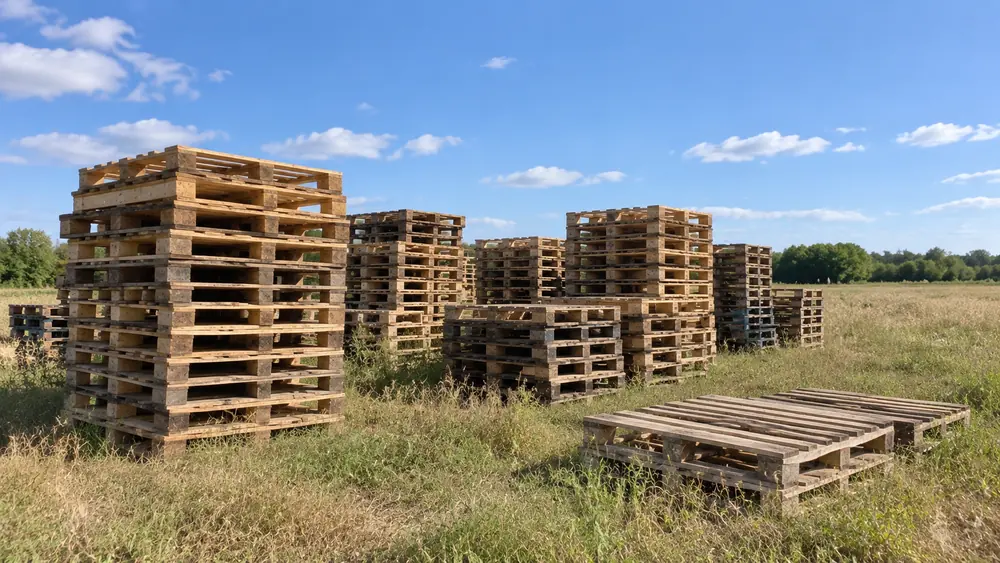
The chalk mark decides everything
Every pallet that comes off a recycling truck gets flipped, sounded and chalk-marked within a few hours of arrival. Sounded means struck with the flat of a hand near each stringer: a solid pallet rings, a cracked one thuds. Graders develop this reflex within about a month and then cannot unlearn it.
Four marks exist in our bay. A single slash means companion stringer. A cross means deck board replacement. A circle means re-nail only. A line through the whole pallet means core — it goes to the de-nailer and its useful boards become somebody else's repair.
The companion stringer, step by step
The repairer cuts a replacement stringer from kiln-dried stock to within an eighth of an inch of the original length. It is positioned hard against the damaged stringer, flush with the top deck so the deck height does not change, and fastened with helical nails through both the top and bottom deck boards.
Helical nails matter. A smooth shank nail withdraws under vibration; a helical nail rotates as it enters and locks into the fibre. The difference in withdrawal resistance is large enough that it changes how long the repair lasts, which is why we do not keep smooth shank nails in the building.
Re-squaring is not optional
After fastening, the pallet goes onto a jig and gets checked corner to corner with a steel square. Our tolerance is a quarter inch. A pallet out of square by more than that will not sit correctly in a rack, will not stack reliably four high, and will eventually drop something.
Roughly one in twelve repairs fails the square check and gets reworked on the spot. That rework is the least glamorous and most important part of the operation.
Then it gets a new name
Every repaired pallet leaves the bay with a fresh Passport ID burned into a stringer and its repair count incremented. Anybody can type that ID into our site and see the cycles, the repairs, the species, the carbon ledger and where it is likely headed next.
We built the Passport partly because customers asked for traceability and partly because it changed how our own crew thinks. When a pallet has a name and a history, nobody wants to be the person who scrapped it unnecessarily.
What this costs, and what it saves
A customer-owned repair run typically costs 40 to 55% of buying replacements. Each repair avoids roughly 11 kg CO₂e and keeps 35 pounds of wood in service. Across a 300-pallet run that is a tonne of avoided emissions and a five-figure saving.
About 14% of incoming repair stock turns out to be beyond economic repair. We tell customers that figure up front, because a repair quote that assumes a 100% success rate is a repair quote that will be revised later.