Skip to content
MenuClose
PalletLinker

Pallet Passport · our one unusual idea

Every pallet gets a name.

A stamp burned into a stringer, two letters and five characters. Type it in and read what that piece of wood has been doing with its life. No app, no login, no battery — a brand mark and a web page that will still work in twenty years.

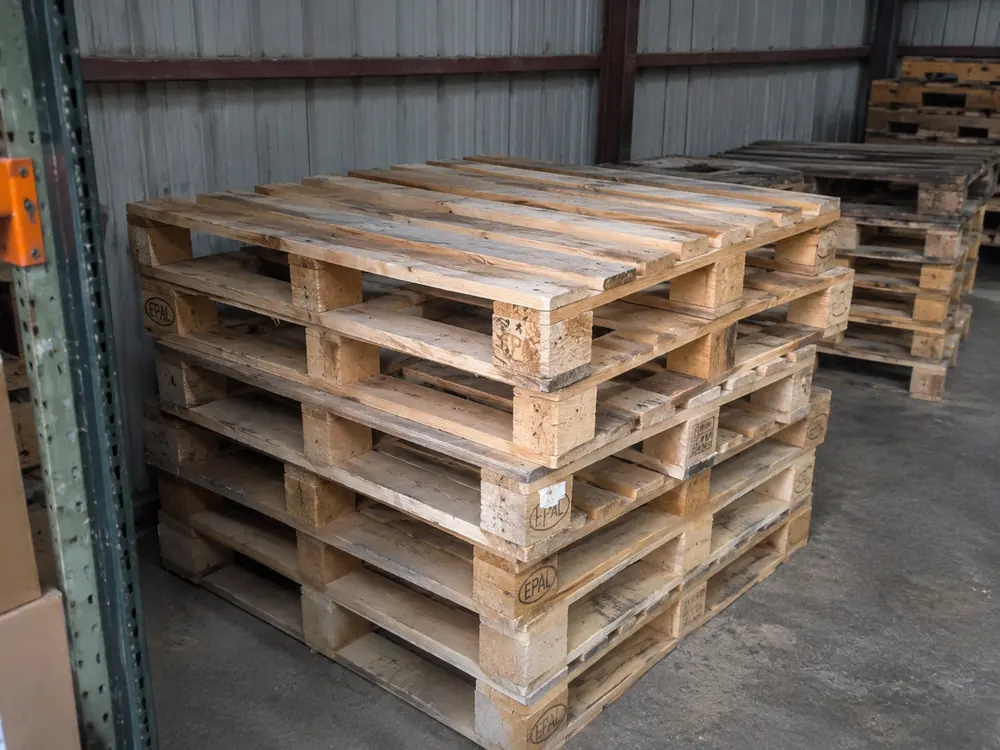
Close view of a single stack of stringer pallets showing deck boards and stamps
48×40 stringer, stamped

Request a quote

Want your own stamped pool?

Every unit we sell carries an ID by default. Tell us the volume and we will include the record set with your first delivery.

Portland, OR · email only, no phone

A mailbox you actually read — this is how we reply.
US or Canada, 10 digits — format (503) 274-0900.
US ZIP or Canadian code.
Type freely or pick from the list.
Whole number — per month or one-time.

Required fields are marked *. We validate every entry, so a typo in your email or ZIP will be flagged before the request is sent. Read our privacy note.

Passport lookup

Enter a stamped ID

Passport

PL-9ZQ6-4

Integrity 93%

Grade Reman · 10 cycles

  • 10trips completed
  • 14,602miles travelled
  • 120 kgCO₂e avoided
  • 2repairs survived
Species
Ponderosa pine
Footprint
48" × 40" block, 4-way
Grade
Reman — Rebuilt from salvaged decking onto a fresh frame.
Born
Coos Bay, OR, 2012
Boards replaced
8 across 2 repairs
Wood kept in service
186 lb
Trees spared (modelled)
1.6
Next step
Sorted into our Grade A pool — the pool most customers buy from.
When it retires
Decking is milled into retail shelving for a Portland bottle shop.

Where it has been

  1. Gresham sheet-metal shop

    Carried powder-coated brackets · summer 2022

  2. St Johns coffee roaster

    Carried green coffee in jute · summer 2026

  3. Beaverton grocery DC

    Carried shelf-stable dry goods · fall 2023

  4. Hood River orchard co-op

    Carried 1,800 lb of canned pears · summer 2020

Records are derived from the stamped ID, our grading log and our route data. Carbon figures use the method published on our carbon math page. Journey entries describe the customer type and season rather than naming the customer.

Why bother

Naming a thing makes people reluctant to waste it

We expected customers to like the Passport. The unexpected part was what it did inside our own yard.

It answered a question we could not

A Willamette Valley winery asked where the wood had been. We knew the grade and roughly where the truck came from, and nothing else. That bothered us for six months before we did something about it.

It changed the scrap decision

When a pallet has a name and a visible history, scrapping it becomes a decision somebody has to justify. Our scrap rate on repairable stock fell in the first year. Nobody was told to repair more.

It deliberately avoids technology

No app, no login, no RFID, no blockchain. All four were suggested. A brand mark burned into Douglas fir is readable by a human with a flashlight in a wet yard in 2046.

How to read a stamp

Anatomy of an ID

PL
Our facility prefix, burned on every unit that crosses the scale.
Four characters
The unit reference — letters and digits, assigned at grading.
Check character
Catches a misread digit when somebody types it in.
Location on the pallet
Always a stringer, never a deck board. Deck boards get replaced; stringers persist through repair.
If the stamp is worn
Email a photo of the stringer. We can usually read it, and we will re-stamp on the next visit.
  • 14kpallets graded monthlytwo hand-grading lines
  • 1,100heat treated per dayISPM-15, chart recorded
  • 4.1M lbwood diverted last year68% reused whole
  • 0 lblandfilled in 2025weighed and reconciled

Questions

What people ask about the Pallet Passport

What is the minimum order or pickup?

No hard minimum for collection at the yard — come and take four pallets on a Saturday morning if you like. For delivery it is 50 units inside Portland metro and 150 outside it, because the truck has to earn its diesel. Outside our 180-mile fleet radius we quote through partner yards and freight, with the lane itemised.

How fast can this happen?

Standard 48×40 Grade A and B stock: same day for pickup, next day for metro delivery. Block pallets one to three days. Custom builds five to nine business days; engineered runs two to three weeks. Heat treatment is same day for booked batches and 48 hours standard. Written quotes always come back within one business day.

Why is there no phone number anywhere?

Because verbal quotes get remembered differently by different people. Since 2018 every price, date and commitment we make exists in an email you can search and forward. Most customers dislike it for about a month and then prefer it. Everything else happens in person at 3821 NW St Helens Rd, Portland, OR 97210.

Can I inspect before committing?

Please do. Visit the yard by email arrangement — closed-toe boots required, hi-vis provided — or ask for photographs of the actual pool your order would come from. We would rather lose an order than have a customer discover a surprise on their dock.

What documentation comes with it?

A written quote, a signed count sheet by grade, a weight ticket where material is weighed, heat-treatment certificates for treated batches (archived seven years), and a monthly diversion certificate for anything we collect for recycling — measured pounds kept out of landfill, which is the figure your ESG report actually needs.

What will you refuse to do?

Take methyl-bromide fumigated, chemically contaminated or fire-damaged wood. Buy marked rental-pool pallets, which belong to their operator. Promise same-day delivery outside the metro. Or quote a grade we do not think will survive your handling — we will specify downward and explain why.

Vocabulary

Terms used on this page

Defined the way a yard uses them, not the way a standards document does.

Companion stringer
A second timber nailed alongside a cracked stringer to span the damage and restore the load path.
Core
Low-grade pallet material bought for board and fibre recovery rather than resale.
HT
Heat treated: 56 °C at the core of the wood for 30 continuous minutes, per ISPM-15.
IPPC mark
The stamp proving treatment: wheat symbol, country code, facility number and treatment code.
Remanufactured (reman)
A pallet rebuilt from salvaged components onto a sound frame, re-squared and re-stamped.
Stringer
The timber running the long dimension of a pallet, carrying load in bending. Three is standard.
Stringer plating
A metal plate reinforcing a cracked stringer. Cheaper than a companion and less durable.
Tare weight
The weight of the empty pallet — a real and rarely audited freight cost.

The full glossary, 36 terms

Lifecycle

Eleven years in the life of one pallet

A composite built from real Passport records. Individual units vary enormously; the shape does not.

  1. Year 0

    Built

    Douglas fir from a mill inside 180 miles. Seven top boards, five bottom, three stringers, helical nails, 2,800 lb dynamic.

  2. Year 0–2

    Trips 1–4

    Beverage route work. Loaded, racked, unloaded, returned. Colour starts to grey; nothing structural changes.

  3. Year 3

    First inspection failure

    A lead board splits at a nail line. Twenty-minute fix: replacement deck board, re-square, re-stamp. Graded B from here.

  4. Year 3–6

    Trips 5–9

    Nursery and agricultural work, where deck gaps matter more than appearance. Spends two winters partly outdoors.

  5. Year 7

    Companion stringer

    A stringer cracks. A second timber is fitted alongside, spanning the crack. Measurably stiffer than before.

  6. Year 7–10

    Trips 10–13

    Local one-way freight. Tare weight has drifted up a pound from accumulated moisture cycling.

  7. Year 11

    Retired from carrying

    Two bottom boards gone, deck softening. Economic repair ends here. Chalk line through the whole pallet.

  8. Year 11

    Dismantled

    De-nailed board by board. Clear boards to the fabrication shop; structural stock back to the repair bay as donor material.

  9. Year 11

    Recovered

    What is left goes through a magnet and a grinder: mulch, bedding shavings, biomass fuel. The nails go to a scrap partner four miles away.

  10. Year 11+

    Still working

    The best boards are now shelving in a bottle shop, carrying its Passport ID burned into the end grain.

Thirteen trips, two repairs, roughly 143 kg CO₂e avoided against building thirteen new pallets, and nothing landfilled at the end. Look up a real record

Reference

Standards, bodies and who decides what

Pallets sit under a surprising number of overlapping rules. Here is who writes them and what they actually govern.

ReferenceWho maintains itWhat it governsDoes it bind a used pallet sale?
ISPM-15IPPC, under the UN FAOTreatment and marking of solid wood packaging in international tradeYes, for export
GMA footprint (48×40)Industry convention, originally grocery manufacturersA footprint, not a quality levelNo — it is a size
EPAL / EUREuropean Pallet AssociationEuro pallet construction, repair and brandingYes, if sold as EPAL
ISO 6780International Organization for StandardizationPrincipal pallet footprints worldwideNo
ASTM D1185 / D1083ASTM InternationalTest methods for pallet performanceNo, but ratings reference them
PDS (Pallet Design System)Virginia Tech / NWPCAEngineering-grade load modellingNo — a design tool
NWPCA uniform standardsNational Wooden Pallet & Container AssociationCommon grade vocabularyVoluntary
OSHA 1910.176US Dept of LaborSafe storage, stacking and housekeepingYes, in your building
Oregon EPR (SB 582)Oregon DEQProducer responsibility for packaging; wood is in scope for reportingIncreasingly, yes
FSMA / food safety plansUS FDAPackaging as a food-contact hazard considerationVia your audit, yes

The gap in that list is the interesting part: no authority grades used pallets. That is why a written supplier specification — ours is published here — is the entire quality system in this industry.

Decision table

Five ways to get a pallet, compared honestly

Including the two we do not sell. Cost index is against a new wooden pallet of the same footprint.

Indicative figures for a 48×40 footprint in the Pacific Northwest, 2026. Rental pool economics vary by contract and are deliberately shown as a range.
OptionCost indexTripsRepairableCarbon per useBest forWatch out for
Grade A recycled45–559–14 then repairYes3.1 kgAlmost everythingColour varies; tare varies by a few pounds
Grade B recycled30–407–11 then repairYes3.1 kgOne-way, floor stacking, closed loopsLower racked rating (1,500 lb)
Remanufactured25–355–8Yes4.8 kgOne-way on a budgetVisibly mixed boards; 1,200 lb racked
New wooden10015–20 then repairYes14.2 kgTight tolerances, audits, odd sizesPays for appearance you may not need
Plastic500–1,00030–100NoHigh embodied, low per-useWash-down, deep freeze, pharmaCracks end its life; not repairable
Rental poolPer-trip feeManagedBy operatorOperator's figureExchange networks, retail mandatesPallets are not yours; losses are chargeable

We sell the first four and supply plastic where a wash-down line genuinely needs it. We do not operate a rental pool, and we will not buy marked pool pallets from you — they belong to their operator. Full comparisons

Next step

Want every pallet you buy to have a name?

It is standard on everything we sell, at no extra cost. Tell us your volume and we will include the record set with the first delivery.

Get a quote