Skip to content
MenuClose
PalletLinker

Buying guide · April 15, 2025

In praise of the pallet collar: the most underrated object in packaging

A hinged wooden frame turns a flat pallet into a box in nine seconds, folds flat for the return trip, and lasts five years. Nobody talks about them.

Soren Whitfield — Fabrication shop lead 5 min · 336 words
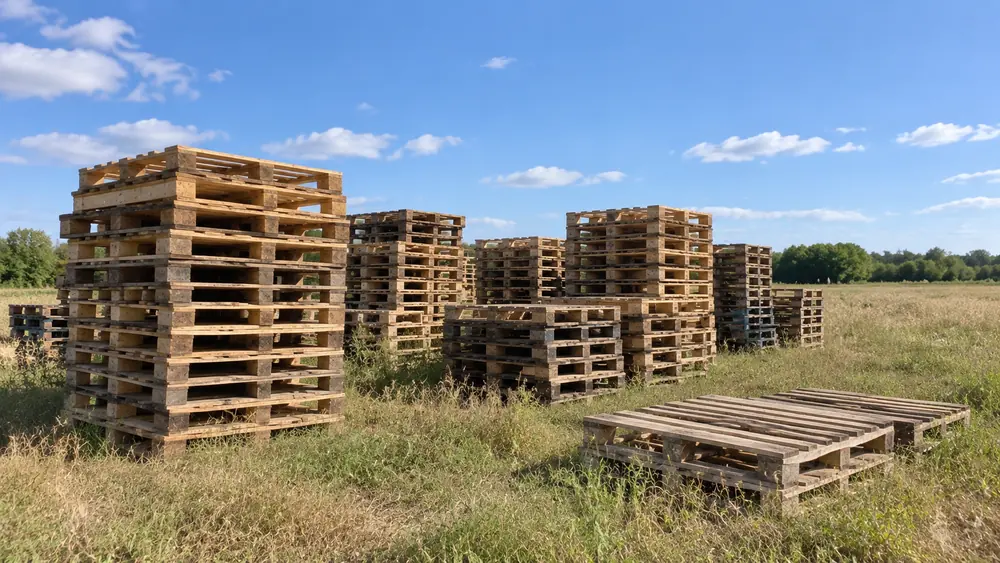
Stacks of reclaimed pallets standing in a grass field under a clear blue skyBuying guide
Seasonal overflow storage

Request a quote

Ask the author, or ask for a price.

This form reaches the yard team who wrote the article. Mention the piece in your message if you want a follow-up on something specific.

Portland, OR · email only, no phone

A mailbox you actually read — this is how we reply.
US or Canada, 10 digits — format (503) 274-0900.
US ZIP or Canadian code.
Type freely or pick from the list.
Whole number — per month or one-time.

Required fields are marked *. We validate every entry, so a typo in your email or ZIP will be flagged before the request is sent. Read our privacy note.

What a collar is

A pallet collar is four wooden boards joined by steel hinges, sized to sit on a standard pallet footprint. Dropped onto a pallet it creates four walls about eight inches high. Stack two collars and you have sixteen inches. Add a top cap and you have a closed box.

Folded flat, a collar is about two inches thick. A hundred of them occupy the space of six pallets, which is why they make sense for return logistics in a way that rigid crates never will.

The nine-second test

We time this when customers visit. Picking up a folded collar, opening it and dropping it onto a pallet takes a practised person about nine seconds. Assembling a corrugated gaylord box takes closer to ninety, and the gaylord lasts one trip.

Across a thousand units a month, that labour difference alone justifies the purchase, before you consider that the collar is still working in year five.

Where collars shine

Loose and irregular goods: nursery pots, automotive returns, scrap metal, textiles, bulk components. Anything that needs containment but not protection from weather.

They are also excellent for mixed-SKU picking, because you can remove the top collar to reach into the load rather than unstacking it. Warehouse crews who try them tend to ask for more.

What to look for when buying

Hinge quality is the whole product. Cheap collars use thin stamped hinges that bend out of true within months, after which the collar will not fold flat and nobody uses it again. Look for heavier gauge steel and screws rather than staples.

Board thickness matters second. We build ours from reclaimed fir decking at full deck thickness, which is heavier than the imported alternatives and survives being dropped by a forklift, which will happen.

The repair angle

Collars are repairable, which is the point. A broken board gets replaced in minutes; a broken hinge gets unscrewed and swapped. A collar with one replaced board is simply a collar, not a downgraded one.

We repair customer collars alongside pallets in the same bay, which is how a five-year service life becomes a ten-year one.

Written by Soren Whitfield, Fabrication shop lead, at the yard on 3821 NW St Helens Rd. Published April 15, 2025.

  • #collars
  • #accessories
  • #reuse

Vocabulary

Terms used on this page

Defined the way a yard uses them, not the way a standards document does.

Block pallet
A pallet supported by nine solid blocks rather than stringers, giving true four-way entry and better racked performance.
Bolster
A squared timber used to block and brace loads inside trailers and containers. We re-saw ours from retired stringers.
Chamfer
The bevelled edge on a bottom deck board that lets a pallet jack roll on without catching.
Companion stringer
A second timber nailed alongside a cracked stringer to span the damage and restore the load path.
Core
Low-grade pallet material bought for board and fibre recovery rather than resale.
Closed loop
A pallet population circulating between known points and returning. Cycle time, not consumption, governs pool size.
Deck board
The boards nailed across stringers or blocks forming the top and bottom surfaces of a pallet.
De-nailer
The machine that separates deck boards from stringers and removes fasteners before fibre recovery.

The full glossary, 36 terms

Process

How a request after reading this actually happens

No sales team, no discovery call, no CRM sequence. We have no telephone, so everything below happens in writing and stays searchable afterwards.

  • What we need: footprint, grade, count, ZIP, and how the pallet is handled.
  • Nice to have: a photo, your dock height, whether you run forklifts or jacks.
  • Not needed: a purchase order, an account, or a phone conversation.
  1. 01

    You send the form

    Every form on this site is the same form and reaches the same yard team. Required fields are validated as you type, so a mistyped ZIP or email is caught before anything is sent.

  2. 02

    We check today's stock

    Used pallet availability moves daily. You get a real count and a real date rather than a list price that was true last quarter.

  3. 03

    A written quote, within one business day

    Price per unit by grade, freight itemised separately, delivery window, and any honest reservations we have about the specification you asked for.

  4. 04

    Delivery, count, paperwork

    Signed count sheet on arrival, weight ticket where relevant, and a diversion certificate for anything we collect for recycling.

  • 14kpallets graded monthlytwo hand-grading lines
  • 1,100heat treated per dayISPM-15, chart recorded
  • 4.1M lbwood diverted last year68% reused whole
  • 0 lblandfilled in 2025weighed and reconciled

Questions

What people ask about working with the yard

What is the minimum order or pickup?

No hard minimum for collection at the yard — come and take four pallets on a Saturday morning if you like. For delivery it is 50 units inside Portland metro and 150 outside it, because the truck has to earn its diesel. Outside our 180-mile fleet radius we quote through partner yards and freight, with the lane itemised.

How fast can this happen?

Standard 48×40 Grade A and B stock: same day for pickup, next day for metro delivery. Block pallets one to three days. Custom builds five to nine business days; engineered runs two to three weeks. Heat treatment is same day for booked batches and 48 hours standard. Written quotes always come back within one business day.

Why is there no phone number anywhere?

Because verbal quotes get remembered differently by different people. Since 2018 every price, date and commitment we make exists in an email you can search and forward. Most customers dislike it for about a month and then prefer it. Everything else happens in person at 3821 NW St Helens Rd, Portland, OR 97210.

Can I inspect before committing?

Please do. Visit the yard by email arrangement — closed-toe boots required, hi-vis provided — or ask for photographs of the actual pool your order would come from. We would rather lose an order than have a customer discover a surprise on their dock.

What documentation comes with it?

A written quote, a signed count sheet by grade, a weight ticket where material is weighed, heat-treatment certificates for treated batches (archived seven years), and a monthly diversion certificate for anything we collect for recycling — measured pounds kept out of landfill, which is the figure your ESG report actually needs.

What will you refuse to do?

Take methyl-bromide fumigated, chemically contaminated or fire-damaged wood. Buy marked rental-pool pallets, which belong to their operator. Promise same-day delivery outside the metro. Or quote a grade we do not think will survive your handling — we will specify downward and explain why.

Decision table

Five ways to get a pallet, compared honestly

Including the two we do not sell. Cost index is against a new wooden pallet of the same footprint.

Indicative figures for a 48×40 footprint in the Pacific Northwest, 2026. Rental pool economics vary by contract and are deliberately shown as a range.
OptionCost indexTripsRepairableCarbon per useBest forWatch out for
Grade A recycled45–559–14 then repairYes3.1 kgAlmost everythingColour varies; tare varies by a few pounds
Grade B recycled30–407–11 then repairYes3.1 kgOne-way, floor stacking, closed loopsLower racked rating (1,500 lb)
Remanufactured25–355–8Yes4.8 kgOne-way on a budgetVisibly mixed boards; 1,200 lb racked
New wooden10015–20 then repairYes14.2 kgTight tolerances, audits, odd sizesPays for appearance you may not need
Plastic500–1,00030–100NoHigh embodied, low per-useWash-down, deep freeze, pharmaCracks end its life; not repairable
Rental poolPer-trip feeManagedBy operatorOperator's figureExchange networks, retail mandatesPallets are not yours; losses are chargeable

We sell the first four and supply plastic where a wash-down line genuinely needs it. We do not operate a rental pool, and we will not buy marked pool pallets from you — they belong to their operator. Full comparisons

Diagnostics

Read the damage, fix the cause

Damage patterns are not random. Each one points at a specific handling behaviour, and fixing the behaviour is worth more than fixing the pallets.

What you seeWhat it almost always meansWhat to changeCost to fix
Split lead boards at one endForks driven in too fast and too highOperator training; dock lighting. Usually one shift is responsibleFree
Torn stringer notchesPallet jacks entering notched stringers at an angleSpecify block pallets with true four-way entrySpec change
Bottom boards ripped off cleanlyPallets dragged rather than lifted, or frozen to a cold-store floorFloor condition, forklift capacity at peakLow
Crushed corner blocksStacks higher than the rating, or uneven loads on one cornerStack-height policy; centre the loadFree
Out of square, nothing brokenRacking loading pallets diagonally — beams at different heightsRack survey. This one is worth chasingMedium
Mould in the middle of a stackWet pallets stacked tight with no airflowStore off the ground, cover the top, leave side gapsLow
Protruding nails tearing casesUngraded stock, or units repaired without re-checkingBuy graded; reject on the ticketFree
Deck boards cuppingMoisture cycling between a freezer and a humid dockKiln-dried pool; helical fastenersSpec change

Keep thirty of your own broken pallets aside for a month and photograph the damage. Patterns appear quickly. We do this analysis free with any repair quote, because a customer whose damage rate halves buys from us for a decade.

Next step

Put this into practice

Every article on this site came out of a customer conversation. Start yours — one form, one business day, written answer.

Get a quote